In Search Of The Essence Of Quantum Machine Learning
How parameterized quantum circuits turn exponential Hilbert spaces into learning models
Classic machine learning already provides universal approximators and massive models. So why resort to quantum circuits? This is the search for the real challenge, namely to design problem-specific circuits that translate theoretical capacities into practical learning.
by Frank ZickertSeptember 2, 2025
What could Quantum Computing is a different kind of computation that builds upon the phenomena of Quantum Mechanics. Learn more about Quantum Computing offer that would justify the effort involved in establishing the new field of Quantum Machine Learning is the field of research that combines principles from quantum computing with traditional machine learning to solve complex problems more efficiently than classical approaches. Learn more about Quantum Machine Learning The bar is set high. Over the past decade, classical Machine Learning is an approach on solving problems by deriving the rules from data instead of explicitly programming. Learn more about Machine Learning has achieved remarkable results. In quantum computing, a **Transformer** refers to an adaptation of the classical Transformer neural network architecture for **quantum data or quantum circuits**. It uses quantum operations (like parameterized quantum gates) to process information in **Hilbert space**, enabling the model to capture quantum correlations that classical Transformers can’t. Essentially, it’s a **quantum analog of attention-based models**, designed to learn from or simulate quantum states and dynamics. Learn more about Transfomer now capture far-reaching dependencies in texts with more than billion parameters. Their results—texts, source code, images, even videos—are often indistinguishable from human work.
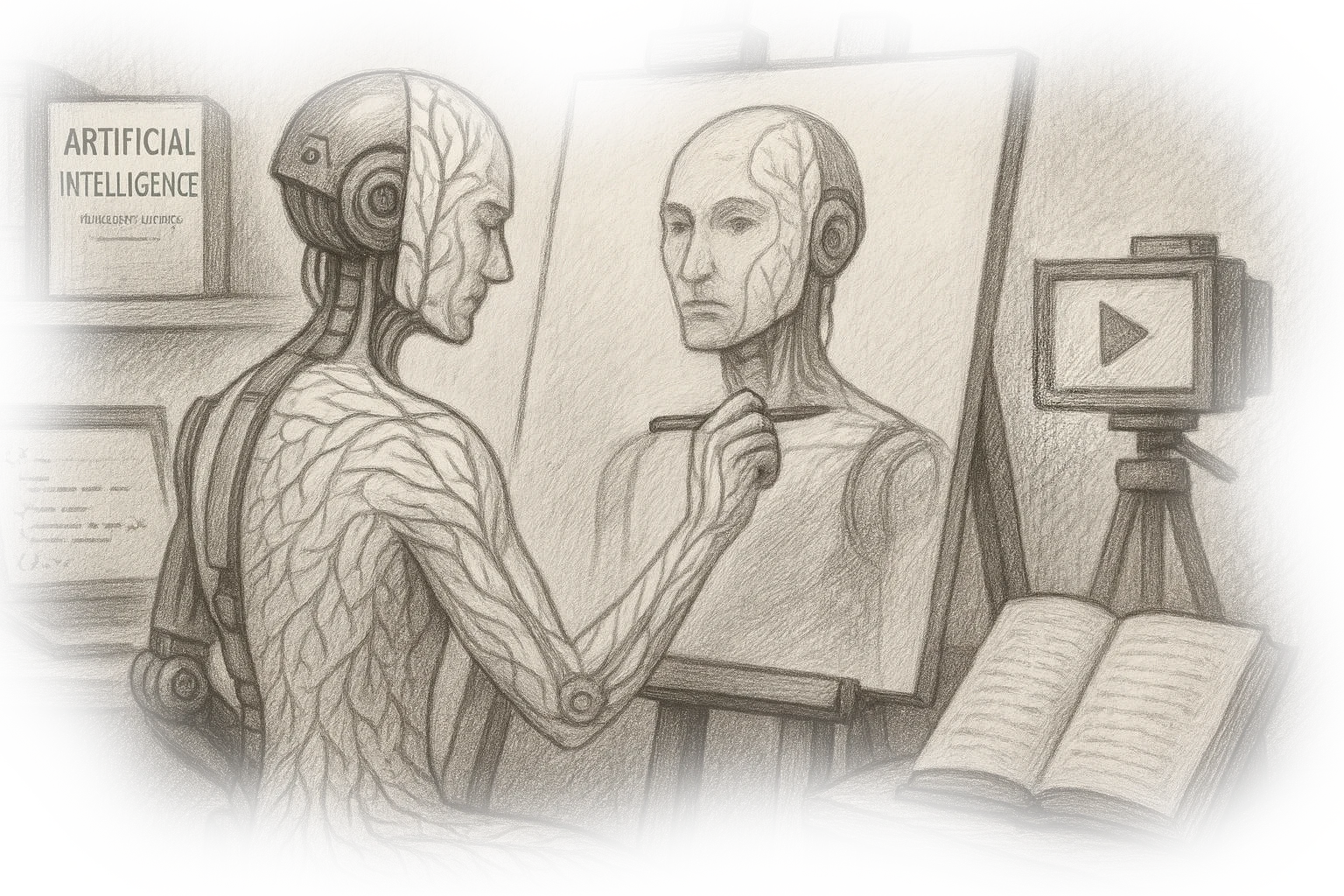
Figure 1 Generative AI creates an image of generative AI... created by generative AI
And that's only one part of it. Classic Machine Learning is an approach on solving problems by deriving the rules from data instead of explicitly programming. Learn more about Machine Learning encompasses much more than Generative Artificial Intelligence refers to systems that can create new content—such as text, images, audio, or code—based on patterns learned from large datasets. Unlike traditional AI that only classifies or predicts, generative AI produces original outputs that resemble human-created data. It works by modeling the probability distributions of data and sampling from them to generate new, coherent examples. Learn more about Generative Artificial Intelligence. An artificial neural network is a computational model of interconnected nodes inspired by biological neurons, used to approximate functions and recognize patterns. Learn more about Neural Network are universal function approximators: with sufficient capacity, they can represent any continuous function. In machine learning, a **kernel** is a function that computes the similarity between data points in a higher-dimensional space without explicitly transforming the data there. This allows algorithms like Support Vector Machines to learn complex, nonlinear relationships efficiently. Essentially, it replaces inner products in feature space with a simpler computation in the original space. Learn more about Kernel map data to high-dimensional A Hilbert space is a complete vector space equipped with an inner product, which allows for measuring angles and lengths between vectors. "Complete" means that every Cauchy sequence of vectors converges to a vector within the space. It generalizes the idea of Euclidean space to possibly infinite dimensions and forms the foundation for quantum mechanics and functional analysis. Learn more about Hilbert Space where linear separation is possible. Optimization is the process of finding the best possible solution to a problem within given constraints. It involves adjusting variables to minimize or maximize an objective function, such as cost, time, or efficiency. In simple terms, it’s about achieving the most effective outcome with the least waste or effort. Learn more about Optimization algorithms such as Stochastic Gradient Descent (SGD) is an optimization algorithm that updates model parameters using the gradient from a single (or small batch of) randomly chosen training sample(s) rather than the full dataset. This makes updates faster but noisier, which can help escape local minima. It iteratively moves parameters in the direction that reduces the loss function until convergence. Learn more about Stochastic Gradient Descent and Adam is an optimization algorithm that updates model weights using both the average of past gradients (momentum) and the average of past squared gradients (adaptive learning rates). This combination helps it converge faster and more stably than vanilla stochastic gradient descent. It adjusts each parameter’s learning rate individually, making it effective for sparse or noisy data. Learn more about Adam can be reliably scaled to millions or billions of parameters. Together, these advances form an arsenal of techniques that dominate tasks in the fields of image processing, language, and structured data alike.
Against this backdrop, we must critically examine the core approach of Quantum Machine Learning is the field of research that combines principles from quantum computing with traditional machine learning to solve complex problems more efficiently than classical approaches. Learn more about Quantum Machine Learning, which focuses on a A **Parameterized Quantum Circuit (PQC)** is a quantum circuit where certain gate operations depend on adjustable parameters—typically real numbers representing rotation angles. These parameters are tuned (often by classical optimization) to perform a specific task, such as minimizing a cost function. PQCs are central to **variational quantum algorithms**, where quantum computation provides state preparation and measurement, and a classical computer optimizes the parameters. Learn more about Parameterized Quantum Circuit as a A **model** in machine learning is a mathematical representation of patterns learned from data. It takes **inputs** (features) and produces **outputs** (predictions or classifications) based on relationships it has identified during training. Essentially, it’s a function that generalizes from examples to make decisions or predictions on new data. Learn more about Model. The A quantum circuit is a sequence of quantum gates applied to qubits, representing the operations in a quantum computation. Each gate changes the qubits’ state using quantum mechanics principles like superposition and entanglement. The final qubit states, when measured, yield the circuit’s computational result probabilistically. Learn more about Quantum Circuit is trained A Variational Quantum Algorithm is a hybrid quantum–classical algorithm in which a quantum circuit is paramterized by a classical routine. This means, it usually computes the values for rotation angles used inside this parameterized quantum circuit during a classical pre-processing step. Additionally, the measurement results are interpreted during a classical post-processing. Learn more about Variational Quantum Algorithm and its parameters are updated through a classical Optimization is the process of finding the best possible solution to a problem within given constraints. It involves adjusting variables to minimize or maximize an objective function, such as cost, time, or efficiency. In simple terms, it’s about achieving the most effective outcome with the least waste or effort. Learn more about Optimization loop. This design turns the A **Parameterized Quantum Circuit (PQC)** is a quantum circuit where certain gate operations depend on adjustable parameters—typically real numbers representing rotation angles. These parameters are tuned (often by classical optimization) to perform a specific task, such as minimizing a cost function. PQCs are central to **variational quantum algorithms**, where quantum computation provides state preparation and measurement, and a classical computer optimizes the parameters. Learn more about Parameterized Quantum Circuit itself into a function approximator that competes directly with An artificial neural network is a computational model of interconnected nodes inspired by biological neurons, used to approximate functions and recognize patterns. Learn more about Neural Network, In machine learning, a **kernel** is a function that computes the similarity between data points in a higher-dimensional space without explicitly transforming the data there. This allows algorithms like Support Vector Machines to learn complex, nonlinear relationships efficiently. Essentially, it replaces inner products in feature space with a simpler computation in the original space. Learn more about Kernel, and other classical architectures.
For such an approach to be viable, a A **Parameterized Quantum Circuit (PQC)** is a quantum circuit where certain gate operations depend on adjustable parameters—typically real numbers representing rotation angles. These parameters are tuned (often by classical optimization) to perform a specific task, such as minimizing a cost function. PQCs are central to **variational quantum algorithms**, where quantum computation provides state preparation and measurement, and a classical computer optimizes the parameters. Learn more about Parameterized Quantum Circuit must offer some representation capacity or computational efficiency that goes beyond what these established A **model** in machine learning is a mathematical representation of patterns learned from data. It takes **inputs** (features) and produces **outputs** (predictions or classifications) based on relationships it has identified during training. Essentially, it’s a function that generalizes from examples to make decisions or predictions on new data. Learn more about Model already achieve. Without this, they run the risk of becoming expensive imitations of methods that already work, and the rationale for Quantum Machine Learning is the field of research that combines principles from quantum computing with traditional machine learning to solve complex problems more efficiently than classical approaches. Learn more about Quantum Machine Learning disappears.
So what does a A quantum algorithm is a step-by-step computational procedure designed to run on a quantum computer, exploiting quantum phenomena such as superposition, entanglement, and interference to solve certain problems more efficiently than classical algorithms. Learn more about Quantum Algorithm offer that a classical algorithm does not? The first real clue comes from comparing how classical and quantum A **model** in machine learning is a mathematical representation of patterns learned from data. It takes **inputs** (features) and produces **outputs** (predictions or classifications) based on relationships it has identified during training. Essentially, it’s a function that generalizes from examples to make decisions or predictions on new data. Learn more about Model expand data. In a classical A **model** in machine learning is a mathematical representation of patterns learned from data. It takes **inputs** (features) and produces **outputs** (predictions or classifications) based on relationships it has identified during training. Essentially, it’s a function that generalizes from examples to make decisions or predictions on new data. Learn more about Model, an input A vector is a mathematical object that has both magnitude (size) and direction. It’s often represented as an arrow or as an ordered list of numbers (components) that describe its position in space, such as . Vectors are used to represent quantities like velocity, force, or displacement. Learn more about Vector is assigned to a Feature space is the multidimensional space where each dimension represents one feature (or variable) used to describe data. Each data point in this space corresponds to an object characterized by its feature values. The structure and distance between points in this space determine similarity, clustering, and classification behavior in machine learning models. Learn more about Feature Space. In this space, the number of A basis state in quantum computing is one of the fundamental states that form the building blocks of a quantum system’s state space. For a single qubit, the basis states are and ; any other qubit state is a superposition of these. In systems with multiple qubits, basis states are all possible combinations of s and s (e.g., , , , and ), forming an orthonormal basis for the system’s Hilbert space. Learn more about Basis State grows polynomially (usually linearly) with the dimension .
A quantum A **model** in machine learning is a mathematical representation of patterns learned from data. It takes **inputs** (features) and produces **outputs** (predictions or classifications) based on relationships it has identified during training. Essentially, it’s a function that generalizes from examples to make decisions or predictions on new data. Learn more about Model, on the other hand, embeds an input into the state space of qubits. This state is a Superposition in quantum computing means a quantum bit (qubit) can exist in multiple states (0 and 1) at the same time, rather than being limited to one like a classical bit. Mathematically, it’s a linear combination of basis states with complex probability amplitudes. This allows quantum computers to process many possible inputs simultaneously, enabling exponential speedups for certain problems. Learn more about Superposition of all computational A basis state in quantum computing is one of the fundamental states that form the building blocks of a quantum system’s state space. For a single qubit, the basis states are and ; any other qubit state is a superposition of these. In systems with multiple qubits, basis states are all possible combinations of s and s (e.g., , , , and ), forming an orthonormal basis for the system’s Hilbert space. Learn more about Basis State. Instead of a polynomially growing set of features, the A quantum circuit is a sequence of quantum gates applied to qubits, representing the operations in a quantum computation. Each gate changes the qubits’ state using quantum mechanics principles like superposition and entanglement. The final qubit states, when measured, yield the circuit’s computational result probabilistically. Learn more about Quantum Circuit opens up access to an exponentially large basis. Each A qubit is the basic unit of quantum information, representing a superposition of 0 and 1 states. Learn more about Quantum Bit doubles the number of accessible states, creating a representation landscape that no classical A **model** in machine learning is a mathematical representation of patterns learned from data. It takes **inputs** (features) and produces **outputs** (predictions or classifications) based on relationships it has identified during training. Essentially, it’s a function that generalizes from examples to make decisions or predictions on new data. Learn more about Model can efficiently match.
Figure 3 Growth of state space, note the y-axis scaling
This shift puts the problem in a new context. The promising potential of A **Parameterized Quantum Circuit (PQC)** is a quantum circuit where certain gate operations depend on adjustable parameters—typically real numbers representing rotation angles. These parameters are tuned (often by classical optimization) to perform a specific task, such as minimizing a cost function. PQCs are central to **variational quantum algorithms**, where quantum computation provides state preparation and measurement, and a classical computer optimizes the parameters. Learn more about Parameterized Quantum Circuit lies not in marginal improvements, but in the fact that they open up a Feature space is the multidimensional space where each dimension represents one feature (or variable) used to describe data. Each data point in this space corresponds to an object characterized by its feature values. The structure and distance between points in this space determine similarity, clustering, and classification behavior in machine learning models. Learn more about Feature Space whose size grows exponentially with the number of A qubit is the basic unit of quantum information, representing a superposition of 0 and 1 states. Learn more about Quantum Bit. This exponential expansion is the structural reason for assuming that a quantum A **model** in machine learning is a mathematical representation of patterns learned from data. It takes **inputs** (features) and produces **outputs** (predictions or classifications) based on relationships it has identified during training. Essentially, it’s a function that generalizes from examples to make decisions or predictions on new data. Learn more about Model could offer an advantage for Machine Learning is an approach on solving problems by deriving the rules from data instead of explicitly programming. Learn more about Machine Learning.
However, access to a A Hilbert space is a complete vector space equipped with an inner product, which allows for measuring angles and lengths between vectors. "Complete" means that every Cauchy sequence of vectors converges to a vector within the space. It generalizes the idea of Euclidean space to possibly infinite dimensions and forms the foundation for quantum mechanics and functional analysis. Learn more about Hilbert Space of dimension is meaningless if the A **model** in machine learning is a mathematical representation of patterns learned from data. It takes **inputs** (features) and produces **outputs** (predictions or classifications) based on relationships it has identified during training. Essentially, it’s a function that generalizes from examples to make decisions or predictions on new data. Learn more about Model does not use it. A quantum In machine learning, a **kernel** is a function that computes the similarity between data points in a higher-dimensional space without explicitly transforming the data there. This allows algorithms like Support Vector Machines to learn complex, nonlinear relationships efficiently. Essentially, it replaces inner products in feature space with a simpler computation in the original space. Learn more about Kernel must do more than embed inputs in a huge space. It must use this space in such a way that a separation is achieved that cannot be achieved with any efficient classical construction.
Figure 4 Naive use of technology does not exploit its full potential.
So even though we know that capacity is exponential, when we use naive Encoding is the process of converting information from one form into another, usually so it can be stored, transmitted, or processed more efficiently. For example, text can be encoded into binary for computers to handle, or sounds into digital signals for transmission. The key idea is that encoding changes the representation, not the meaning, of the data. Learn more about Encoding we fall back on forms that also classical In machine learning, a **kernel** is a function that computes the similarity between data points in a higher-dimensional space without explicitly transforming the data there. This allows algorithms like Support Vector Machines to learn complex, nonlinear relationships efficiently. Essentially, it replaces inner products in feature space with a simpler computation in the original space. Learn more about Kernel can approximate, too. Any possible Quantum advantage is the point where a quantum computer performs a specific task faster or more efficiently than the best possible classical computer. It doesn’t mean quantum computers are universally better—just that they outperform classical ones for that task. The first demonstrations (e.g., Google’s 2019 Sycamore experiment) showed speedups for highly specialized problems, not yet for practical applications. Learn more about Quantum Advantage vanishes. The unresolved problem therefore lies in finding out how data An embedding is a numerical representation of data (like words, images, or documents) in a continuous vector space where similar items are close together. It captures semantic or structural relationships by encoding features into dense vectors. Embeddings are used in machine learning to make non-numeric data comparable and computable. Learn more about Embedding and algorithms can be designed that actually make use of the exponential structure. Until then, the exponentially growing A Hilbert space is a complete vector space equipped with an inner product, which allows for measuring angles and lengths between vectors. "Complete" means that every Cauchy sequence of vectors converges to a vector within the space. It generalizes the idea of Euclidean space to possibly infinite dimensions and forms the foundation for quantum mechanics and functional analysis. Learn more about Hilbert Space remains a theoretical promise rather than a practical advantage.
Fortunately, Quantum Machine Learning is the field of research that combines principles from quantum computing with traditional machine learning to solve complex problems more efficiently than classical approaches. Learn more about Quantum Machine Learning is an active area of research. And there is a number of publications that show how access to an exponentially large A Hilbert space is a complete vector space equipped with an inner product, which allows for measuring angles and lengths between vectors. "Complete" means that every Cauchy sequence of vectors converges to a vector within the space. It generalizes the idea of Euclidean space to possibly infinite dimensions and forms the foundation for quantum mechanics and functional analysis. Learn more about Hilbert Space.
Yet, unfortunately, that research is not precisely beginner-friendly. Because the articles sound something like this:
Define the A **Quantum Feature Map** is a process that converts classical input data into a **quantum state** using a parameterized quantum circuit. This transformation encodes data into the **high-dimensional Hilbert space** of a quantum system, allowing quantum algorithms to exploit complex correlations not easily captured classically. Essentially, it’s the quantum analogue of feature mapping in machine learning, used to make data more separable for classification or regression tasks. Learn more about Quantum Feature Map and the associated quantum In machine learning, a **kernel** is a function that computes the similarity between data points in a higher-dimensional space without explicitly transforming the data there. This allows algorithms like Support Vector Machines to learn complex, nonlinear relationships efficiently. Essentially, it replaces inner products in feature space with a simpler computation in the original space. Learn more about Kernel as the Quantum state overlap measures how similar two quantum states are. Mathematically, it’s the absolute square of their inner product: ( |\langle \psi | \phi \rangle|^2 ), which ranges from 0 (completely different) to 1 (identical). It represents the probability that one state would be found if the system were measured in the other state’s basis. Learn more about Quantum State Overlap
For any positive semidefinite In machine learning, a **kernel** is a function that computes the similarity between data points in a higher-dimensional space without explicitly transforming the data there. This allows algorithms like Support Vector Machines to learn complex, nonlinear relationships efficiently. Essentially, it replaces inner products in feature space with a simpler computation in the original space. Learn more about Kernel, there exists a unique A **Reproducing Kernel Hilbert Space (RKHS)** is a Hilbert space of functions where evaluating a function at any point can be done via an inner product with a special function called the **kernel**. This kernel encodes similarity between inputs and ensures all evaluation functionals are continuous. RKHSs are central to kernel methods (e.g., SVMs, Gaussian processes) because they let algorithms operate implicitly in high-dimensional feature spaces. Learn more about Reproducing Kernel Hilbert Space of functions with An inner product is a mathematical operation that takes two vectors and returns a single number measuring how similar or aligned they are. In Euclidean space, it’s the sum of the products of corresponding components (e.g., ). It generalizes the dot product and defines geometric concepts likelength and angle in vector spaces. Learn more about Inner Product, characterized by the reproducing property:
In the case of , the A **Reproducing Kernel Hilbert Space (RKHS)** is a Hilbert space of functions where evaluating a function at any point can be done via an inner product with a special function called the **kernel**. This kernel encodes similarity between inputs and ensures all evaluation functionals are continuous. RKHSs are central to kernel methods (e.g., SVMs, Gaussian processes) because they let algorithms operate implicitly in high-dimensional feature spaces. Learn more about Reproducing Kernel Hilbert Space is the closure of finite linear combinations of the quantum features . Havlicek, V., 2019, Nature, Vol. 567, pp. 209-212 show that for certain Encoding is the process of converting information from one form into another, usually so it can be stored, transmitted, or processed more efficiently. For example, text can be encoded into binary for computers to handle, or sounds into digital signals for transmission. The key idea is that encoding changes the representation, not the meaning, of the data. Learn more about Encoding, constructed from commuting A quantum circuit is a sequence of quantum gates applied to qubits, representing the operations in a quantum computation. Each gate changes the qubits’ state using quantum mechanics principles like superposition and entanglement. The final qubit states, when measured, yield the circuit’s computational result probabilistically. Learn more about Quantum Circuit approximating the In machine learning, a **kernel** is a function that computes the similarity between data points in a higher-dimensional space without explicitly transforming the data there. This allows algorithms like Support Vector Machines to learn complex, nonlinear relationships efficiently. Essentially, it replaces inner products in feature space with a simpler computation in the original space. Learn more about Kernel
to additive error is classically hard on average, unless the The **Polynomial Hierarchy (PH)** is a layered generalization of NP and co-NP that organizes decision problems by how many alternating quantifiers (∃ and ∀) are needed in their logical definitions. Each level, denoted Σₖᴾ or Πₖᴾ, represents problems solvable by a polynomial-time machine with access to an oracle for the previous level. If any two adjacent levels collapse (e.g., Σₖᴾ = Πₖᴾ), the entire hierarchy collapses to that level. Learn more about Polynomial Hierarchy collapses. Thus, while In machine learning, a **kernel** is a function that computes the similarity between data points in a higher-dimensional space without explicitly transforming the data there. This allows algorithms like Support Vector Machines to learn complex, nonlinear relationships efficiently. Essentially, it replaces inner products in feature space with a simpler computation in the original space. Learn more about Kernel values can be efficiently estimated on a A quantum computer is typically a large, highly controlled system kept at near-absolute-zero temperatures to preserve quantum behavior. It contains a processor with qubits—often made from superconducting circuits, trapped ions, or photons—manipulated by microwaves, lasers, or magnetic fields. Surrounding systems handle cooling, error correction, and control electronics to maintain quantum coherence and read out results. Learn more about Quantum Computer, they are conjectured to be intractable to approximate classically.
Consequently, the A **Reproducing Kernel Hilbert Space (RKHS)** is a Hilbert space of functions where evaluating a function at any point can be done via an inner product with a special function called the **kernel**. This kernel encodes similarity between inputs and ensures all evaluation functionals are continuous. RKHSs are central to kernel methods (e.g., SVMs, Gaussian processes) because they let algorithms operate implicitly in high-dimensional feature spaces. Learn more about Reproducing Kernel Hilbert Space is computationally accessible only with quantum resources, establishing a separation in computational expressivity between quantum and classical kernel methods.
The findings in the literature are rigorous, but not always practical. They prove that certain A **quantum kernel** is a function that measures the similarity between data points by mapping them into a **quantum feature space** using a quantum circuit. It’s used in **quantum machine learning** to compute inner products between these quantum states, capturing complex relationships that may be hard for classical kernels to represent. In short, it lets quantum systems generate richer feature mappings for kernel-based algorithms like SVMs. Learn more about Quantum Kernel are difficult to approximate classically. Yet, they do not explain how to develop working models for real data sets. There are two main challenges here.
Challenge 1: Choosing useful encodings
It is easy to write a function with the corresponding kernel . The difficult part is designing so that the kernel does two things at once:
captures the structure of the actual learning problem and
remains provably hard to approximate classically, while still being trainable on real quantum hardware.
McClean, J.R., 2018, Nature Communications, Vol. 9, pp. 4812 In this setting, A **gradient** is a vector that shows the direction and rate of the steepest increase of a function. Each component of the gradient is the **partial derivative** of the function with respect to one input variable. In optimization, it tells you how to adjust inputs to increase or decrease the function’s output most efficiently. Learn more about Gradient disappear exponentially fast with the number of A qubit is the basic unit of quantum information, representing a superposition of 0 and 1 states. Learn more about Quantum Bit, a problem known as The barren plateau problem in quantum computing refers to regions in a quantum circuit’s parameter space where the **gradient of the cost function becomes exponentially small** as the number of qubits increases. This makes training variational quantum algorithms (like VQEs or QNNs) extremely difficult because optimization algorithms receive almost no useful signal to guide updates. It’s primarily caused by random circuit initialization and high circuit depth, leading to near-random output states. Learn more about Barren Plateau. This makesOptimization is the process of finding the best possible solution to a problem within given constraints. It involves adjusting variables to minimize or maximize an objective function, such as cost, time, or efficiency. In simple terms, it’s about achieving the most effective outcome with the least waste or effort. Learn more about Optimization practically impossible without additional structure or careful initialization.
Therefore, it is not enough to simply place a model in the vast A Hilbert space is a complete vector space equipped with an inner product, which allows for measuring angles and lengths between vectors. "Complete" means that every Cauchy sequence of vectors converges to a vector within the space. It generalizes the idea of Euclidean space to possibly infinite dimensions and forms the foundation for quantum mechanics and functional analysis. Learn more about Hilbert Space. But the A quantum circuit is a sequence of quantum gates applied to qubits, representing the operations in a quantum computation. Each gate changes the qubits’ state using quantum mechanics principles like superposition and entanglement. The final qubit states, when measured, yield the circuit’s computational result probabilistically. Learn more about Quantum Circuit architecture must be chosen in such a way that learning remains possible.
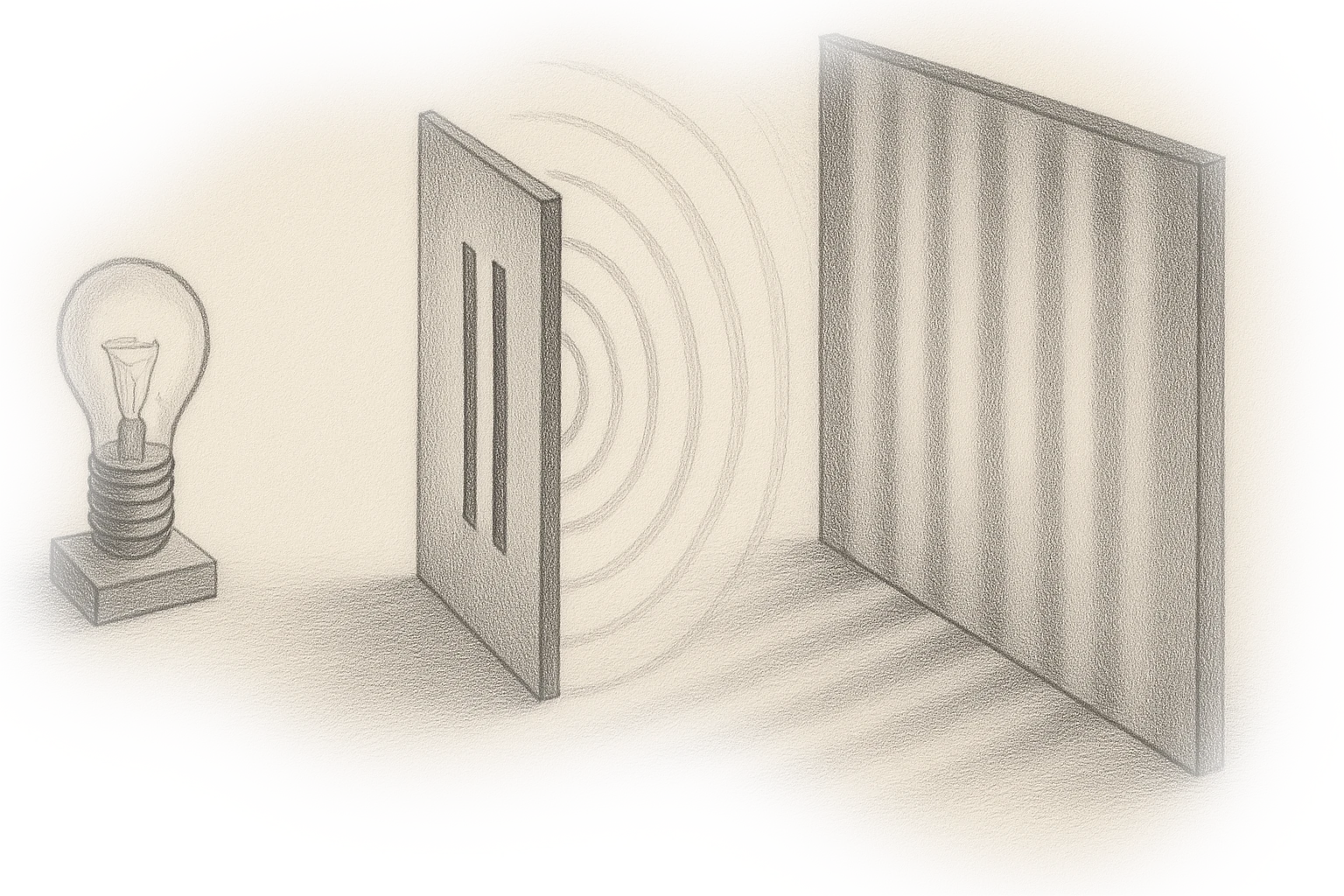
Figure 5 The double-slit experiment
The key mechanism for accessing the exponential A Hilbert space is a complete vector space equipped with an inner product, which allows for measuring angles and lengths between vectors. "Complete" means that every Cauchy sequence of vectors converges to a vector within the space. It generalizes the idea of Euclidean space to possibly infinite dimensions and forms the foundation for quantum mechanics and functional analysis. Learn more about Hilbert Space is Interference in quantum computing refers to the way probability amplitudes of quantum states combine—sometimes reinforcing each other (constructive interference) or canceling out (destructive interference). Quantum algorithms exploit this to amplify the probability of correct answers while suppressing incorrect ones. It’s a key mechanism that gives quantum computers their computational advantage. Learn more about Interference. When a A quantum circuit is a sequence of quantum gates applied to qubits, representing the operations in a quantum computation. Each gate changes the qubits’ state using quantum mechanics principles like superposition and entanglement. The final qubit states, when measured, yield the circuit’s computational result probabilistically. Learn more about Quantum Circuit is running, the system Unitary evolution is the rule that describes how a closed quantum system changes over time according to the Schrödinger equation. The system’s state vector is transformed by a *unitary operator*, meaning probabilities (the total norm) are exactly preserved. This ensures quantum evolution is reversible and information is never lost. Learn more about Unitary Evolution into a Superposition in quantum computing means a quantum bit (qubit) can exist in multiple states (0 and 1) at the same time, rather than being limited to one like a classical bit. Mathematically, it’s a linear combination of basis states with complex probability amplitudes. This allows quantum computers to process many possible inputs simultaneously, enabling exponential speedups for certain problems. Learn more about Superposition of many computational paths. Each path contributes a In quantum computing an amplitude is a complex number that describes the weight of a basis state in a quantum superposition. The squared magnitude of an amplitude gives the probability of measuring that basis state. Amplitudes can interfere, this means adding or canceling, allowing quantum algorithms to bias outcomes toward correct solutions. Learn more about Amplitude and the probability of an outcome depends on the square of the sum of these In quantum computing an amplitude is a complex number that describes the weight of a basis state in a quantum superposition. The squared magnitude of an amplitude gives the probability of measuring that basis state. Amplitudes can interfere, this means adding or canceling, allowing quantum algorithms to bias outcomes toward correct solutions. Learn more about Amplitude.
By tuning the A quantum gate is a basic operation that changes the state of one or more qubits, similar to how a logic gate operates on bits in classical computing. It uses unitary transformations, meaning it preserves the total probability (the state’s length in complex space). Quantum gates enable superposition and entanglement, allowing quantum computers to perform computations that classical ones cannot efficiently replicate. Learn more about Quantum Gate parameters, you change how the paths reinforce or cancel each other out. This selective Interference in quantum computing refers to the way probability amplitudes of quantum states combine—sometimes reinforcing each other (constructive interference) or canceling out (destructive interference). Quantum algorithms exploit this to amplify the probability of correct answers while suppressing incorrect ones. It’s a key mechanism that gives quantum computers their computational advantage. Learn more about Interference allows the A quantum circuit is a sequence of quantum gates applied to qubits, representing the operations in a quantum computation. Each gate changes the qubits’ state using quantum mechanics principles like superposition and entanglement. The final qubit states, when measured, yield the circuit’s computational result probabilistically. Learn more about Quantum Circuit to highlight certain patterns in the input and suppress others. The effect is a A **decision boundary** is the line or surface that separates different classes in a classification problem. It represents where a model is equally uncertain between two or more classes (e.g., where predicted probabilities are 0.5 vs. 0.5). Points on one side of the boundary are classified as one class, and points on the other side as another. Learn more about Decision Boundary that can be highly nonlinear and structured. In classical A **model** in machine learning is a mathematical representation of patterns learned from data. It takes **inputs** (features) and produces **outputs** (predictions or classifications) based on relationships it has identified during training. Essentially, it’s a function that generalizes from examples to make decisions or predictions on new data. Learn more about Model capturing the same pattern would often require deep An artificial neural network is a computational model of interconnected nodes inspired by biological neurons, used to approximate functions and recognize patterns. Learn more about Neural Network or a large number of parameters.
In physics, the The double-slit experiment shows that light and particles like electrons act as both waves and particles. When they pass through two slits, they create an interference pattern on a screen—evidence of wave behavior. But if you measure which slit each particle goes through, the interference disappears, revealing particle-like behavior instead. Learn more about Double Slit shows how a particle's probability distribution depends on constructive and destructive Interference in quantum computing refers to the way probability amplitudes of quantum states combine—sometimes reinforcing each other (constructive interference) or canceling out (destructive interference). Quantum algorithms exploit this to amplify the probability of correct answers while suppressing incorrect ones. It’s a key mechanism that gives quantum computers their computational advantage. Learn more about Interference of two possible paths. In circuit form, the same effect is created with just three gates:
A The Hadamard operator, often denoted H, is a single-qubit quantum gate that creates an equal superposition of and . In other words, It turns the states of the computational basis and into the states of the Fourier basis and . Learn more about Hadamard Operator puts the A qubit is the basic unit of quantum information, representing a superposition of 0 and 1 states. Learn more about Quantum Bit into a Superposition in quantum computing means a quantum bit (qubit) can exist in multiple states (0 and 1) at the same time, rather than being limited to one like a classical bit. Mathematically, it’s a linear combination of basis states with complex probability amplitudes. This allows quantum computers to process many possible inputs simultaneously, enabling exponential speedups for certain problems. Learn more about Superposition of is a basis state. Learn more about and is a basis state. Learn more about .
A rotation around the -axis, , introduces a A **quantum phase** is the angle component of a particle’s wavefunction that determines how its probability amplitude interferes with others. It doesn’t affect observable probabilities directly but becomes crucial when comparing two or more states, as phase differences lead to interference effects. Essentially, it encodes the relative timing or “alignment” of quantum waves. Learn more about Quantum Phase that depends on the input data .
A second The Hadamard operator, often denoted H, is a single-qubit quantum gate that creates an equal superposition of and . In other words, It turns the states of the computational basis and into the states of the Fourier basis and . Learn more about Hadamard Operator brings the two paths back together so that their In quantum computing an amplitude is a complex number that describes the weight of a basis state in a quantum superposition. The squared magnitude of an amplitude gives the probability of measuring that basis state. Amplitudes can interfere, this means adding or canceling, allowing quantum algorithms to bias outcomes toward correct solutions. Learn more about AmplitudeInterference in quantum computing refers to the way probability amplitudes of quantum states combine—sometimes reinforcing each other (constructive interference) or canceling out (destructive interference). Quantum algorithms exploit this to amplify the probability of correct answers while suppressing incorrect ones. It’s a key mechanism that gives quantum computers their computational advantage. Learn more about Interference.
The resulting probability of measuring outcome is then
while outcome occurs with probability
As you can see, both probabilities depend on the sine and cosine of the specified rotation around the -axis that determines the A **quantum phase** is the angle component of a particle’s wavefunction that determines how its probability amplitude interferes with others. It doesn’t affect observable probabilities directly but becomes crucial when comparing two or more states, as phase differences lead to interference effects. Essentially, it encodes the relative timing or “alignment” of quantum waves. Learn more about Quantum Phase.
This explanation is quite mathematical. It's more than time to make the principle tangible and look at it in practical terms.
The following listing depicts the core of the circuit implementation in Qiskit is an open-source Python framework for programming and simulating quantum computers. It lets users create quantum circuits, run them on real quantum hardware or simulators, and analyze the results. Essentially, it bridges high-level quantum algorithms with low-level hardware execution. Learn more about Qiskit.
double_slit.py
1
2
3
4
5
6
7
8
9
10
11
defdouble_slit_single_qubit():
qr = QuantumRegister(1, "qr")
cr = ClassicalRegister(1, "cr")
theta = Parameter("theta")
qc = QuantumCircuit(qr, cr, name="double_slit")
qc.h(qr[0])
qc.rz(theta, qr[0])
qc.h(qr[0])
qc.measure(qr[0], cr[0])
return qc, theta
We define a quantum circuit with two registers.
defines a quantum register with a single A qubit is the basic unit of quantum information, representing a superposition of 0 and 1 states. Learn more about Quantum Bit.
defines a classical register with one classical bit to store the measurement outcome.
We add three A quantum gate is a basic operation that changes the state of one or more qubits, similar to how a logic gate operates on bits in classical computing. It uses unitary transformations, meaning it preserves the total probability (the state’s length in complex space). Quantum gates enable superposition and entanglement, allowing quantum computers to perform computations that classical ones cannot efficiently replicate. Learn more about Quantum Gate and a In quantum computing, measurement is the process of extracting classical information from a quantum state. It collapses a qubit’s superposition into one of its basis states (usually or ), with probabilities determined by the amplitudes of those states. After measurement, the qubit’s state becomes definite, destroying the original superposition. Learn more about Measurement to our circuit:
The puts the A qubit is the basic unit of quantum information, representing a superposition of 0 and 1 states. Learn more about Quantum Bit into a Superposition in quantum computing means a quantum bit (qubit) can exist in multiple states (0 and 1) at the same time, rather than being limited to one like a classical bit. Mathematically, it’s a linear combination of basis states with complex probability amplitudes. This allows quantum computers to process many possible inputs simultaneously, enabling exponential speedups for certain problems. Learn more about Superposition state in which the In quantum computing an amplitude is a complex number that describes the weight of a basis state in a quantum superposition. The squared magnitude of an amplitude gives the probability of measuring that basis state. Amplitudes can interfere, this means adding or canceling, allowing quantum algorithms to bias outcomes toward correct solutions. Learn more about Amplitude of both A basis state in quantum computing is one of the fundamental states that form the building blocks of a quantum system’s state space. For a single qubit, the basis states are and ; any other qubit state is a superposition of these. In systems with multiple qubits, basis states are all possible combinations of s and s (e.g., , , , and ), forming an orthonormal basis for the system’s Hilbert space. Learn more about Basis State are equal. In other words, if we were to measure this A quantum state is the complete mathematical description of a quantum system, containing all the information needed to predict measurement outcomes. It’s usually represented by a wavefunction or a state vector in a Hilbert space. The state defines probabilities, not certainties, for observable quantities like position, momentum, or spin. Learn more about Quantum State, we would measure and with the same probability.
The applies a rotation around the -axis by the angle that we take as an external parameter . This means, it is not yet fixed at a certain value but is specified when we use the quantum circuit. The rotation does not affect the measurement probability of either A basis state in quantum computing is one of the fundamental states that form the building blocks of a quantum system’s state space. For a single qubit, the basis states are and ; any other qubit state is a superposition of these. In systems with multiple qubits, basis states are all possible combinations of s and s (e.g., , , , and ), forming an orthonormal basis for the system’s Hilbert space. Learn more about Basis State. But it changes the A **quantum phase** is the angle component of a particle’s wavefunction that determines how its probability amplitude interferes with others. It doesn’t affect observable probabilities directly but becomes crucial when comparing two or more states, as phase differences lead to interference effects. Essentially, it encodes the relative timing or “alignment” of quantum waves. Learn more about Quantum Phase of is a basis state. Learn more about .
The moves the A quantum state vector is a mathematical object (usually denoted |ψ⟩) that fully describes the state of a quantum system. Its components give the probability amplitudes for finding the system in each possible basis state. The squared magnitude of each component gives the probability of measuring that corresponding outcome. Learn more about Quantum State Vector away from a Superposition in quantum computing means a quantum bit (qubit) can exist in multiple states (0 and 1) at the same time, rather than being limited to one like a classical bit. Mathematically, it’s a linear combination of basis states with complex probability amplitudes. This allows quantum computers to process many possible inputs simultaneously, enabling exponential speedups for certain problems. Learn more about Superposition state in which both A basis state in quantum computing is one of the fundamental states that form the building blocks of a quantum system’s state space. For a single qubit, the basis states are and ; any other qubit state is a superposition of these. In systems with multiple qubits, basis states are all possible combinations of s and s (e.g., , , , and ), forming an orthonormal basis for the system’s Hilbert space. Learn more about Basis State have an In quantum computing an amplitude is a complex number that describes the weight of a basis state in a quantum superposition. The squared magnitude of an amplitude gives the probability of measuring that basis state. Amplitudes can interfere, this means adding or canceling, allowing quantum algorithms to bias outcomes toward correct solutions. Learn more about Amplitude of the same size. Depending on the A **quantum phase** is the angle component of a particle’s wavefunction that determines how its probability amplitude interferes with others. It doesn’t affect observable probabilities directly but becomes crucial when comparing two or more states, as phase differences lead to interference effects. Essentially, it encodes the relative timing or “alignment” of quantum waves. Learn more about Quantum Phase applied, it moves either in the direction of is a basis state. Learn more about or in the direction of is a basis state. Learn more about .
The final measures the qubit in the The computational basis is the standard set of basis states used to describe qubits in quantum computing. These are typically and for a single qubit. For multi-qubit systems all possible combinations of basis states denote the computational basis, like , , , and . These states correspond to classical bit strings and form an orthonormal basis for the system's Hilbert space. Any quantum state can be expressed as a superposition of these computational basis states. Learn more about Computational Basis and puts the result into the classical register cr.
This function the quantum circuit qc and the parameter theta.
If you look at the mathematical explanation of our circuit again, you will see that we do not feed ("theta") directly into the - operator, but rather . This a function ("phi") of .
This function serves as a feature mapping that translates the external variable into the actual gate angle used in the circuit. It implements a simple linear transformation:
where controls how many oscillations of the Interference in quantum computing refers to the way probability amplitudes of quantum states combine—sometimes reinforcing each other (constructive interference) or canceling out (destructive interference). Quantum algorithms exploit this to amplify the probability of correct answers while suppressing incorrect ones. It’s a key mechanism that gives quantum computers their computational advantage. Learn more about Interference pattern occur over the interval . introduces a phase shift along the -axis.
This mapping ensures that the measurement probabilities and exhibit the characteristic sinusoidal patterns associated with the Interference in quantum computing refers to the way probability amplitudes of quantum states combine—sometimes reinforcing each other (constructive interference) or canceling out (destructive interference). Quantum algorithms exploit this to amplify the probability of correct answers while suppressing incorrect ones. It’s a key mechanism that gives quantum computers their computational advantage. Learn more about Interference of individual A qubit is the basic unit of quantum information, representing a superposition of 0 and 1 states. Learn more about Quantum Bit, with adjustable frequency and phase shift. These parameters and are optional and are therefore sometimes omitted for the sake of conciseness.
The corresponding function in Python is straightforward:
double_slit.py
1
2
3
defphi(x, w=1.0, b=0.0):
# Data-to-phase map: phi(x) = w * x + b
returnfloat(w * x + b)
In the next step, we use our double_slit circuit.
double_slit.py
1
2
3
4
5
6
7
8
9
10
11
12
13
qc, theta = double_slit_single_qubit()
x = pi
val = phi(x, w=3.0, b=0.6)
bound = qc.assign_parameters({theta: val})
simulator = Aer.get_backend("aer_simulator")
result = simulator.run(bound, shots=1_000).result()
We start with a Classical preprocessing in quantum computing refers to the use of classical algorithms to prepare data, parameters, or problem instances before they’re fed into a quantum algorithm. It often involves tasks like encoding input data into quantum states or reducing a problem’s complexity so the quantum part can focus on what it does best. Essentially, it’s the classical setup work that makes the quantum computation efficient and meaningful. Learn more about Classical Preprocessing, we create the actual circuit to be executed.
We and obtain its instance and an instance of the parameter theta.
We spcify and map it into a circuit parameter through the feature map phi. This step turns classical data into a phase angle. With w=3.0, we specify to pack three oscillations into the range between and . Further, we specify the starting offset to be b=0.1.
Next the symbolic placeholder . This makes the circuit concrete: when executed, it rotates exactly by this phase. Without this binding, the circuit is just a template.
In the next block, we run the quantum circuit. In our case, a localQuantum simulation uses controllable quantum systems (like qubits or cold atoms) to model and study other quantum systems that are too complex for classical computers to calculate. It exploits quantum mechanics directly—superposition and entanglement—to replicate a target system’s behavior. This allows scientists to investigate materials, chemical reactions, or quantum phenomena that would otherwise be computationally intractable. Learn more about Quantum Simulation will do.
We specify an ,
times,
,
and of measuring the qubit as either or .
Finally, we .
The following listing depicts the measurement output.
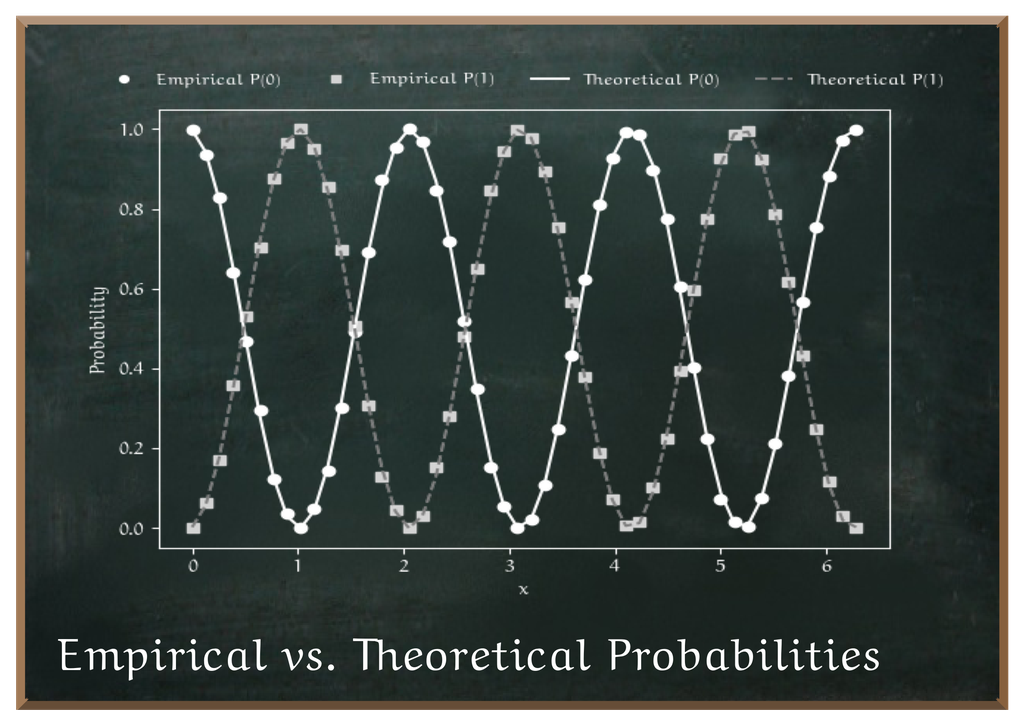
As we can see, our empiric results are close to the calculated theoretical values.
Before you try all the different values for manually, let's write a brief convenience function to do that for us. When we run our circuit in a loop for x in np.linspace(0, 2*np.pi, 50), we get points between and .
The following figure shows the plotted empirical results along the calculated theoretial values.
Figure 6 The results of the quantum circuit
The output of the double-slit circuit is not a linear threshold but a smooth, periodic curve. The measurement probability oscillates (here times) as a cosine squared of the input phase. That periodicity is the direct result of Interference in quantum computing refers to the way probability amplitudes of quantum states combine—sometimes reinforcing each other (constructive interference) or canceling out (destructive interference). Quantum algorithms exploit this to amplify the probability of correct answers while suppressing incorrect ones. It’s a key mechanism that gives quantum computers their computational advantage. Learn more about Interference between the two computational paths.
To mimic this behavior in a classical A **model** in machine learning is a mathematical representation of patterns learned from data. It takes **inputs** (features) and produces **outputs** (predictions or classifications) based on relationships it has identified during training. Essentially, it’s a function that generalizes from examples to make decisions or predictions on new data. Learn more about Model, you would need to generate the same sinusoidal dependence on the input. That is why, when comparing to a feedforward An artificial neural network is a computational model of interconnected nodes inspired by biological neurons, used to approximate functions and recognize patterns. Learn more about Neural Network, the relevant question becomes: how well can it approximate functions like ? A ReLU network can only generate piecewise linear functions, so approximating a smooth periodic curve like requires hidden units to reach accuracy . The quantum circuit does it with depth and one parameter.
The circuit in Qiskit is an open-source Python framework for programming and simulating quantum computers. It lets users create quantum circuits, run them on real quantum hardware or simulators, and analyze the results. Essentially, it bridges high-level quantum algorithms with low-level hardware execution. Learn more about Qiskit is minimal. But it impressively shows how Interference in quantum computing refers to the way probability amplitudes of quantum states combine—sometimes reinforcing each other (constructive interference) or canceling out (destructive interference). Quantum algorithms exploit this to amplify the probability of correct answers while suppressing incorrect ones. It’s a key mechanism that gives quantum computers their computational advantage. Learn more about Interference patterns encode input-dependent A **decision boundary** is the line or surface that separates different classes in a classification problem. It represents where a model is equally uncertain between two or more classes (e.g., where predicted probabilities are 0.5 vs. 0.5). Points on one side of the boundary are classified as one class, and points on the other side as another. Learn more about Decision Boundary. It is the most direct method to see how A **Parameterized Quantum Circuit (PQC)** is a quantum circuit where certain gate operations depend on adjustable parameters—typically real numbers representing rotation angles. These parameters are tuned (often by classical optimization) to perform a specific task, such as minimizing a cost function. PQCs are central to **variational quantum algorithms**, where quantum computation provides state preparation and measurement, and a classical computer optimizes the parameters. Learn more about Parameterized Quantum Circuit use Superposition in quantum computing means a quantum bit (qubit) can exist in multiple states (0 and 1) at the same time, rather than being limited to one like a classical bit. Mathematically, it’s a linear combination of basis states with complex probability amplitudes. This allows quantum computers to process many possible inputs simultaneously, enabling exponential speedups for certain problems. Learn more about Superposition and Interference in quantum computing refers to the way probability amplitudes of quantum states combine—sometimes reinforcing each other (constructive interference) or canceling out (destructive interference). Quantum algorithms exploit this to amplify the probability of correct answers while suppressing incorrect ones. It’s a key mechanism that gives quantum computers their computational advantage. Learn more about Interference to convert A **quantum phase** is the angle component of a particle’s wavefunction that determines how its probability amplitude interferes with others. It doesn’t affect observable probabilities directly but becomes crucial when comparing two or more states, as phase differences lead to interference effects. Essentially, it encodes the relative timing or “alignment” of quantum waves. Learn more about Quantum Phase information into a nonlinear classification signal.
A **Parameterized Quantum Circuit (PQC)** is a quantum circuit where certain gate operations depend on adjustable parameters—typically real numbers representing rotation angles. These parameters are tuned (often by classical optimization) to perform a specific task, such as minimizing a cost function. PQCs are central to **variational quantum algorithms**, where quantum computation provides state preparation and measurement, and a classical computer optimizes the parameters. Learn more about Parameterized Quantum Circuit do not strive for general universality. They target specific structures that are costly for classical A **model** in machine learning is a mathematical representation of patterns learned from data. It takes **inputs** (features) and produces **outputs** (predictions or classifications) based on relationships it has identified during training. Essentially, it’s a function that generalizes from examples to make decisions or predictions on new data. Learn more about Model, such as periodic decision boundaries. Therefore, A quantum circuit is a sequence of quantum gates applied to qubits, representing the operations in a quantum computation. Each gate changes the qubits’ state using quantum mechanics principles like superposition and entanglement. The final qubit states, when measured, yield the circuit’s computational result probabilistically. Learn more about Quantum Circuit are precise tools that are valuable not everywhere, but precisely where classical methods are oversized in scope and depth.
The big challenge in Quantum Machine Learning is the field of research that combines principles from quantum computing with traditional machine learning to solve complex problems more efficiently than classical approaches. Learn more about Quantum Machine Learning lies not in pure expressiveness, but in modeling. A A **Parameterized Quantum Circuit (PQC)** is a quantum circuit where certain gate operations depend on adjustable parameters—typically real numbers representing rotation angles. These parameters are tuned (often by classical optimization) to perform a specific task, such as minimizing a cost function. PQCs are central to **variational quantum algorithms**, where quantum computation provides state preparation and measurement, and a classical computer optimizes the parameters. Learn more about Parameterized Quantum Circuit has exponential capacity, but this capacity is useless if it is not shaped by the structure of the learning task. Just as with classical In machine learning, a **kernel** is a function that computes the similarity between data points in a higher-dimensional space without explicitly transforming the data there. This allows algorithms like Support Vector Machines to learn complex, nonlinear relationships efficiently. Essentially, it replaces inner products in feature space with a simpler computation in the original space. Learn more about Kernel methods, the effectiveness of a quantum kernel or A **Parameterized Quantum Circuit (PQC)** is a quantum circuit where certain gate operations depend on adjustable parameters—typically real numbers representing rotation angles. These parameters are tuned (often by classical optimization) to perform a specific task, such as minimizing a cost function. PQCs are central to **variational quantum algorithms**, where quantum computation provides state preparation and measurement, and a classical computer optimizes the parameters. Learn more about Parameterized Quantum Circuit depends on the problem domain. A useful model must exploit quantum correlations in a way that is tailored to the specific structure of the task.
Progress is achieved through architectures and training methods tailored to real-world problems, not by striving for larger A Hilbert space is a complete vector space equipped with an inner product, which allows for measuring angles and lengths between vectors. "Complete" means that every Cauchy sequence of vectors converges to a vector within the space. It generalizes the idea of Euclidean space to possibly infinite dimensions and forms the foundation for quantum mechanics and functional analysis. Learn more about Hilbert Space. The advantage of A quantum circuit is a sequence of quantum gates applied to qubits, representing the operations in a quantum computation. Each gate changes the qubits’ state using quantum mechanics principles like superposition and entanglement. The final qubit states, when measured, yield the circuit’s computational result probabilistically. Learn more about Quantum Circuit will only be realized if they are developed to solve specific learning tasks and not to demonstrate Quantum mechanics is the branch of physics that describes the behavior of matter and energy at atomic and subatomic scales. Learn more about Quantum Mechanics.