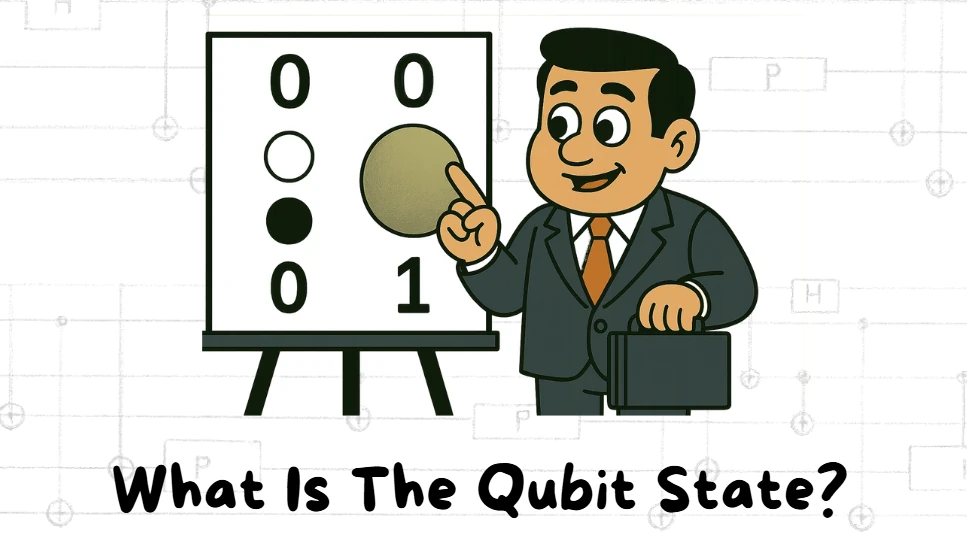
A qubit is not like a classical bit. Stop comparing them!
A qubit is not a classical bit that can be both 0 and 1! A qubit doesn't store values at all; it defines probabilities.
by Frank ZickertOctober 8, 2025
Many beginner's guides to Quantum Computing is a different kind of computation that builds upon the phenomena of Quantum Mechanics. Learn more about Quantum Computing claim that a A qubit is the basic unit of quantum information, representing a superposition of 0 and 1 states. Learn more about Quantum Bit is just like a classical bit, only more advanced, as it can be both and at the same time. This idea is simply wrong.
This post is accompanied by a PDF file summarizing the key points.
Please Login to Download the PDF (your PyQML subscription works here!)
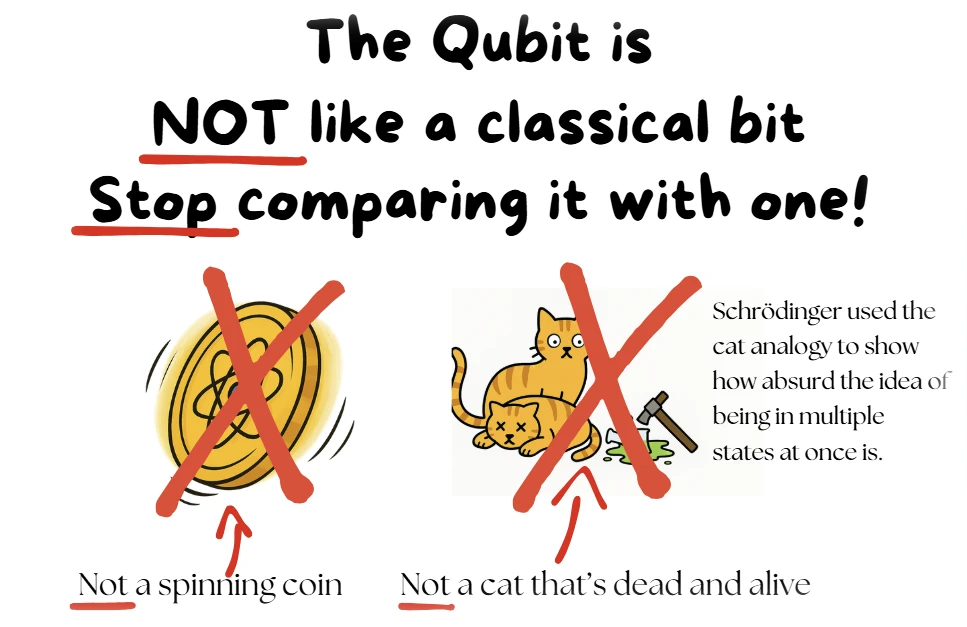
However, accepting this idea leads to confusing analogies about spinning coins and cats that are both dead and alive, but still does not explain what a A quantum state is the complete mathematical description of a quantum system, containing all the information needed to predict measurement outcomes. It’s usually represented by a wavefunction or a state vector in a Hilbert space. The state defines probabilities, not certainties, for observable quantities like position, momentum, or spin. Learn more about Quantum State actually represents. Nor is it possible to design or think about quantum programs in this way, since a A qubit is the basic unit of quantum information, representing a superposition of 0 and 1 states. Learn more about Quantum Bit functions according to completely different principles than a classical bit.
Figure 1 The qubit is not like a classical bit. Stop comparing it.
If you treat a A qubit is the basic unit of quantum information, representing a superposition of 0 and 1 states. Learn more about Quantum Bit as something that is both and , you are pursuing the wrong idea. This leads to questions such as What is it really? or How does it decide when it is observed?. These are questions that have no practical significance. The result is confusion, empty metaphors, and code that makes no sense.
A classical bit stores binary information: it is either or . A A qubit is the basic unit of quantum information, representing a superposition of 0 and 1 states. Learn more about Quantum Bit does not store information in this way. It is not or , and it is certainly not both at the same time. It does not contain a binary value. It only generates one as a In quantum computing, measurement is the process of extracting classical information from a quantum state. It collapses a qubit’s superposition into one of its basis states (usually or ), with probabilities determined by the amplitudes of those states. After measurement, the qubit’s state becomes definite, destroying the original superposition. Learn more about Measurement result when observed.
What may seem like like splitting hairs is actually crucial. There is a clear distinction between what a A qubit is the basic unit of quantum information, representing a superposition of 0 and 1 states. Learn more about Quantum Bitis (its A quantum state is the complete mathematical description of a quantum system, containing all the information needed to predict measurement outcomes. It’s usually represented by a wavefunction or a state vector in a Hilbert space. The state defines probabilities, not certainties, for observable quantities like position, momentum, or spin. Learn more about Quantum State) and what it produces (its In quantum computing, measurement is the process of extracting classical information from a quantum state. It collapses a qubit’s superposition into one of its basis states (usually or ), with probabilities determined by the amplitudes of those states. After measurement, the qubit’s state becomes definite, destroying the original superposition. Learn more about Measurement result).
A A qubit is the basic unit of quantum information, representing a superposition of 0 and 1 states. Learn more about Quantum Bit is a controlled probability generator whose A quantum state is the complete mathematical description of a quantum system, containing all the information needed to predict measurement outcomes. It’s usually represented by a wavefunction or a state vector in a Hilbert space. The state defines probabilities, not certainties, for observable quantities like position, momentum, or spin. Learn more about Quantum State you can set before In quantum computing, measurement is the process of extracting classical information from a quantum state. It collapses a qubit’s superposition into one of its basis states (usually or ), with probabilities determined by the amplitudes of those states. After measurement, the qubit’s state becomes definite, destroying the original superposition. Learn more about Measurement.
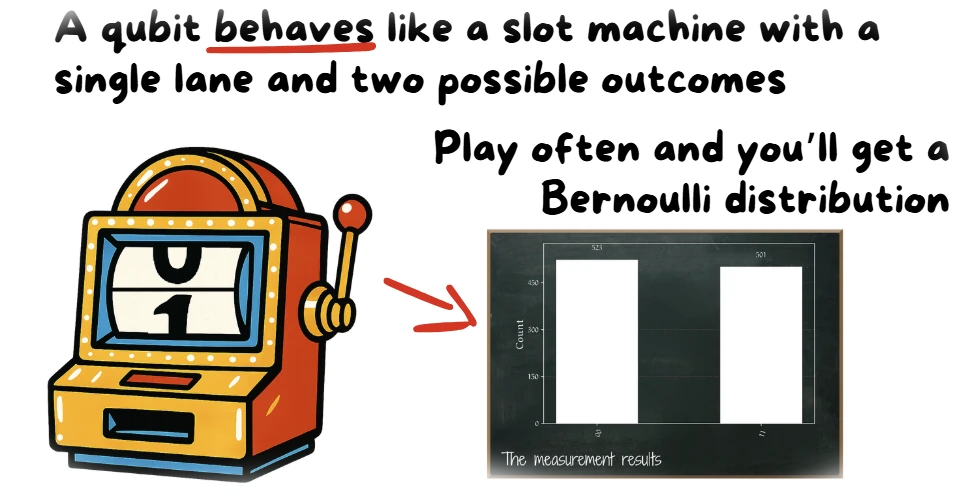
In quantum computing, measurement is the process of extracting classical information from a quantum state. It collapses a qubit’s superposition into one of its basis states (usually or ), with probabilities determined by the amplitudes of those states. After measurement, the qubit’s state becomes definite, destroying the original superposition. Learn more about Measurement a A qubit is the basic unit of quantum information, representing a superposition of 0 and 1 states. Learn more about Quantum Bit produces samples as an outcome. Each sample is either or , and there is nothing mysterious about that. The frequency of these outcomes entirely derives from the probability distribution defined by the A qubit is the basic unit of quantum information, representing a superposition of 0 and 1 states. Learn more about Quantum BitA quantum state is the complete mathematical description of a quantum system, containing all the information needed to predict measurement outcomes. It’s usually represented by a wavefunction or a state vector in a Hilbert space. The state defines probabilities, not certainties, for observable quantities like position, momentum, or spin. Learn more about Quantum State. So, if you prepare and measure many identical A qubit is the basic unit of quantum information, representing a superposition of 0 and 1 states. Learn more about Quantum Bit their outcomes follow aA Bernoulli distribution models a random experiment with exactly two possible outcomes: success (1) with probability (p) and failure (0) with probability (1 - p). It’s the simplest discrete probability distribution and serves as the basis for the binomial distribution. The mean is (p) and the variance is (p(1 - p)). Learn more about Bernoulli Distribution where the relative number of and reveals the underlying probability. But it does not reveal the A qubit is the basic unit of quantum information, representing a superposition of 0 and 1 states. Learn more about Quantum BitA quantum state is the complete mathematical description of a quantum system, containing all the information needed to predict measurement outcomes. It’s usually represented by a wavefunction or a state vector in a Hilbert space. The state defines probabilities, not certainties, for observable quantities like position, momentum, or spin. Learn more about Quantum State that defines it.
Figure 2 The qubit is a controlled probability generator
This perspective makes it possible to think clearly about the A qubit is the basic unit of quantum information, representing a superposition of 0 and 1 states. Learn more about Quantum Bit. The task is not to imagine how two values can exist at the same time. The task is to understand how the A quantum state is the complete mathematical description of a quantum system, containing all the information needed to predict measurement outcomes. It’s usually represented by a wavefunction or a state vector in a Hilbert space. The state defines probabilities, not certainties, for observable quantities like position, momentum, or spin. Learn more about Quantum State encodes the balance between them. Once you see the A qubit is the basic unit of quantum information, representing a superposition of 0 and 1 states. Learn more about Quantum Bit as a controlled probability generator rather than a binary switch, Quantum Computing is a different kind of computation that builds upon the phenomena of Quantum Mechanics. Learn more about Quantum Computing becomes much less mysterious.
This controllable generator contains the true structure of a A qubit is the basic unit of quantum information, representing a superposition of 0 and 1 states. Learn more about Quantum Bit: the A quantum state vector is a mathematical object (usually denoted |ψ⟩) that fully describes the state of a quantum system. Its components give the probability amplitudes for finding the system in each possible basis state. The squared magnitude of each component gives the probability of measuring that corresponding outcome. Learn more about Quantum State Vector. This is not a single number that directly indicates that this A qubit is the basic unit of quantum information, representing a superposition of 0 and 1 states. Learn more about Quantum Bit has a probability of being . It is a direction in a small two-dimensional space that defines these probabilities.
Think of it as an arrow that can point anywhere between the directionspure and pure . Where the arrow points determines the result statistics when you measure: the closer it is to the side, the more often you get ; tilt it toward , and becomes more likely. The exact position of the arrow says nothing about the next result. It defines thedistribution that the A qubit is the basic unit of quantum information, representing a superposition of 0 and 1 states. Learn more about Quantum Bit follows over many In quantum computing, measurement is the process of extracting classical information from a quantum state. It collapses a qubit’s superposition into one of its basis states (usually or ), with probabilities determined by the amplitudes of those states. After measurement, the qubit’s state becomes definite, destroying the original superposition. Learn more about Measurement
Figure 3 Enter caption here
A key challenge is that the probabilities of all possible outcomes must always add up to one (). For a system such as the A qubit is the basic unit of quantum information, representing a superposition of 0 and 1 states. Learn more about Quantum Bit, which has only two possible outcomes, this means that as the probability of increases, the probability of must decrease. The two cannot rise or fall independently of each other; the gain of one is always the loss of the other.
Join to continue
This part is available to PyQML students and above. Log in or start a subscription to unlock member content.
Already a member? Use Log in. New here? Choose Subscribe.
For this reason, the A quantum state vector is a mathematical object (usually denoted |ψ⟩) that fully describes the state of a quantum system. Its components give the probability amplitudes for finding the system in each possible basis state. The squared magnitude of each component gives the probability of measuring that corresponding outcome. Learn more about Quantum State Vector must be normalized. Geometrically, you can imagine that the arrow moves evenly around a circle. Its direction determines how the total probability, which is always , is divided between the two outcomes, but the total probability itself never changes. If the arrow points straight up, this corresponds to a probability of ; if it points straight down, this corresponds to a probability of ; and if it is in the middle, this corresponds to an even split. The constant length of the arrow represents this Normalization in quantum computing means that the total probability of all possible outcomes of a quantum state must equal 1. Mathematically, if a quantum state is written as a vector of complex amplitudes, the sum of the squares of their magnitudes must be 1. This ensures that when the quantum state is measured, one of the possible outcomes will definitely occur. Learn more about Normalization: regardless of how it is tilted, the total probability always remains .
Figure 4 Enter caption here
The closer the head of the A quantum state vector is a mathematical object (usually denoted |ψ⟩) that fully describes the state of a quantum system. Its components give the probability amplitudes for finding the system in each possible basis state. The squared magnitude of each component gives the probability of measuring that corresponding outcome. Learn more about Quantum State Vector is to one pole, the greater its distance to the opposite pole. These distances define the In quantum computing an amplitude is a complex number that describes the weight of a basis state in a quantum superposition. The squared magnitude of an amplitude gives the probability of measuring that basis state. Amplitudes can interfere, this means adding or canceling, allowing quantum algorithms to bias outcomes toward correct solutions. Learn more about Amplitude and , where is the In quantum computing an amplitude is a complex number that describes the weight of a basis state in a quantum superposition. The squared magnitude of an amplitude gives the probability of measuring that basis state. Amplitudes can interfere, this means adding or canceling, allowing quantum algorithms to bias outcomes toward correct solutions. Learn more about Amplitude associated with is a basis state. Learn more about and is the amplitude associated with is a basis state. Learn more about . The probabilities of measuring or are the absolute squares of these amplitudes.
If measuring a A qubit is the basic unit of quantum information, representing a superposition of 0 and 1 states. Learn more about Quantum Bit behaves like a Bernoulli process, a random bit with probability of being , why don't we just describe it with this single number ? Why do we need an entire A quantum state vector is a mathematical object (usually denoted |ψ⟩) that fully describes the state of a quantum system. Its components give the probability amplitudes for finding the system in each possible basis state. The squared magnitude of each component gives the probability of measuring that corresponding outcome. Learn more about Quantum State Vector instead?
Figure 5 Rotate the quantum state vector by the angle θ
This is because the A quantum state is the complete mathematical description of a quantum system, containing all the information needed to predict measurement outcomes. It’s usually represented by a wavefunction or a state vector in a Hilbert space. The state defines probabilities, not certainties, for observable quantities like position, momentum, or spin. Learn more about Quantum State does more than just define the finalIn quantum computing, measurement is the process of extracting classical information from a quantum state. It collapses a qubit’s superposition into one of its basis states (usually or ), with probabilities determined by the amplitudes of those states. After measurement, the qubit’s state becomes definite, destroying the original superposition. Learn more about Measurement probability. It also determines how the system behavesbefore the In quantum computing, measurement is the process of extracting classical information from a quantum state. It collapses a qubit’s superposition into one of its basis states (usually or ), with probabilities determined by the amplitudes of those states. After measurement, the qubit’s state becomes definite, destroying the original superposition. Learn more about Measurement and describes how the A qubit is the basic unit of quantum information, representing a superposition of 0 and 1 states. Learn more about Quantum Bit evolves when A quantum gate is a basic operation that changes the state of one or more qubits, similar to how a logic gate operates on bits in classical computing. It uses unitary transformations, meaning it preserves the total probability (the state’s length in complex space). Quantum gates enable superposition and entanglement, allowing quantum computers to perform computations that classical ones cannot efficiently replicate. Learn more about Quantum Gate act on it.
We need a richer structure because operations in Quantum Computing is a different kind of computation that builds upon the phenomena of Quantum Mechanics. Learn more about Quantum Computing do more than just shift probability from one outcome to another. If we had only a single number , each operation could only increase or decrease that value. This would make a A quantum circuit is a sequence of quantum gates applied to qubits, representing the operations in a quantum computation. Each gate changes the qubits’ state using quantum mechanics principles like superposition and entanglement. The final qubit states, when measured, yield the circuit’s computational result probabilistically. Learn more about Quantum Circuit behave like a complicated random coin toss, but nothing more.
The A quantum state vector is a mathematical object (usually denoted |ψ⟩) that fully describes the state of a quantum system. Its components give the probability amplitudes for finding the system in each possible basis state. The squared magnitude of each component gives the probability of measuring that corresponding outcome. Learn more about Quantum State Vector, on the other hand, allows us to shift the state of the A qubit is the basic unit of quantum information, representing a superposition of 0 and 1 states. Learn more about Quantum Bit in a geometric space, not just between and . This additional structure allows different operations to combine and interact in ways that create new probability patterns when the A qubit is the basic unit of quantum information, representing a superposition of 0 and 1 states. Learn more about Quantum Bit is finally measured.
In short, using a vector gives the A qubit is the basic unit of quantum information, representing a superposition of 0 and 1 states. Learn more about Quantum Bit more freedom of movement. It enables transformations that reshape the distribution of probabilities, not just how much one side wins or loses. This richer behavior gives Quantum Computing is a different kind of computation that builds upon the phenomena of Quantum Mechanics. Learn more about Quantum Computing its power beyond ordinary randomness.
That's the practical model to carry forward:
A A qubit is the basic unit of quantum information, representing a superposition of 0 and 1 states. Learn more about Quantum BitA quantum state vector is a mathematical object (usually denoted |ψ⟩) that fully describes the state of a quantum system. Its components give the probability amplitudes for finding the system in each possible basis state. The squared magnitude of each component gives the probability of measuring that corresponding outcome. Learn more about Quantum State Vector encodes probabilities, not hidden values.
In quantum computing, measurement is the process of extracting classical information from a quantum state. It collapses a qubit’s superposition into one of its basis states (usually or ), with probabilities determined by the amplitudes of those states. After measurement, the qubit’s state becomes definite, destroying the original superposition. Learn more about Measurement converts those probabilities into a definite result.
A quantum gate is a basic operation that changes the state of one or more qubits, similar to how a logic gate operates on bits in classical computing. It uses unitary transformations, meaning it preserves the total probability (the state’s length in complex space). Quantum gates enable superposition and entanglement, allowing quantum computers to perform computations that classical ones cannot efficiently replicate. Learn more about Quantum Gate are rotations that control those probabilities.
Figure 6 Learn how to bring the qubit into a favorable state
This is why the A quantum state vector is a mathematical object (usually denoted |ψ⟩) that fully describes the state of a quantum system. Its components give the probability amplitudes for finding the system in each possible basis state. The squared magnitude of each component gives the probability of measuring that corresponding outcome. Learn more about Quantum State Vector is so important. It is not a hidden value that can be read out, but rather the internal configuration of theA qubit is the basic unit of quantum information, representing a superposition of 0 and 1 states. Learn more about Quantum Bit probability mechanism. When we initialize the A qubit is the basic unit of quantum information, representing a superposition of 0 and 1 states. Learn more about Quantum Bit or apply A quantum gate is a basic operation that changes the state of one or more qubits, similar to how a logic gate operates on bits in classical computing. It uses unitary transformations, meaning it preserves the total probability (the state’s length in complex space). Quantum gates enable superposition and entanglement, allowing quantum computers to perform computations that classical ones cannot efficiently replicate. Learn more about Quantum Gate, we rotate this arrow to adjust the probabilities. At the moment of In quantum computing, measurement is the process of extracting classical information from a quantum state. It collapses a qubit’s superposition into one of its basis states (usually or ), with probabilities determined by the amplitudes of those states. After measurement, the qubit’s state becomes definite, destroying the original superposition. Learn more about Measurement, nature draws a single sample from the distribution defined by this direction, a clear or that matches the probabilities encoded in the A quantum state vector is a mathematical object (usually denoted |ψ⟩) that fully describes the state of a quantum system. Its components give the probability amplitudes for finding the system in each possible basis state. The squared magnitude of each component gives the probability of measuring that corresponding outcome. Learn more about Quantum State Vector.