What Makes Amplitude Encoding So Attractive For Certain Algorithms
The hidden cost that decides whether amplitude encoding works for you
Amplitude encoding seems powerful, but it comes with fixed upfront costs and a major limitation: once your data is stored in amplitudes, you can no longer check it entry by entry. See what you lose, what you gain, and why only a small group of algorithms can actually benefit from it.
by Frank ZickertJanuary 11, 2026
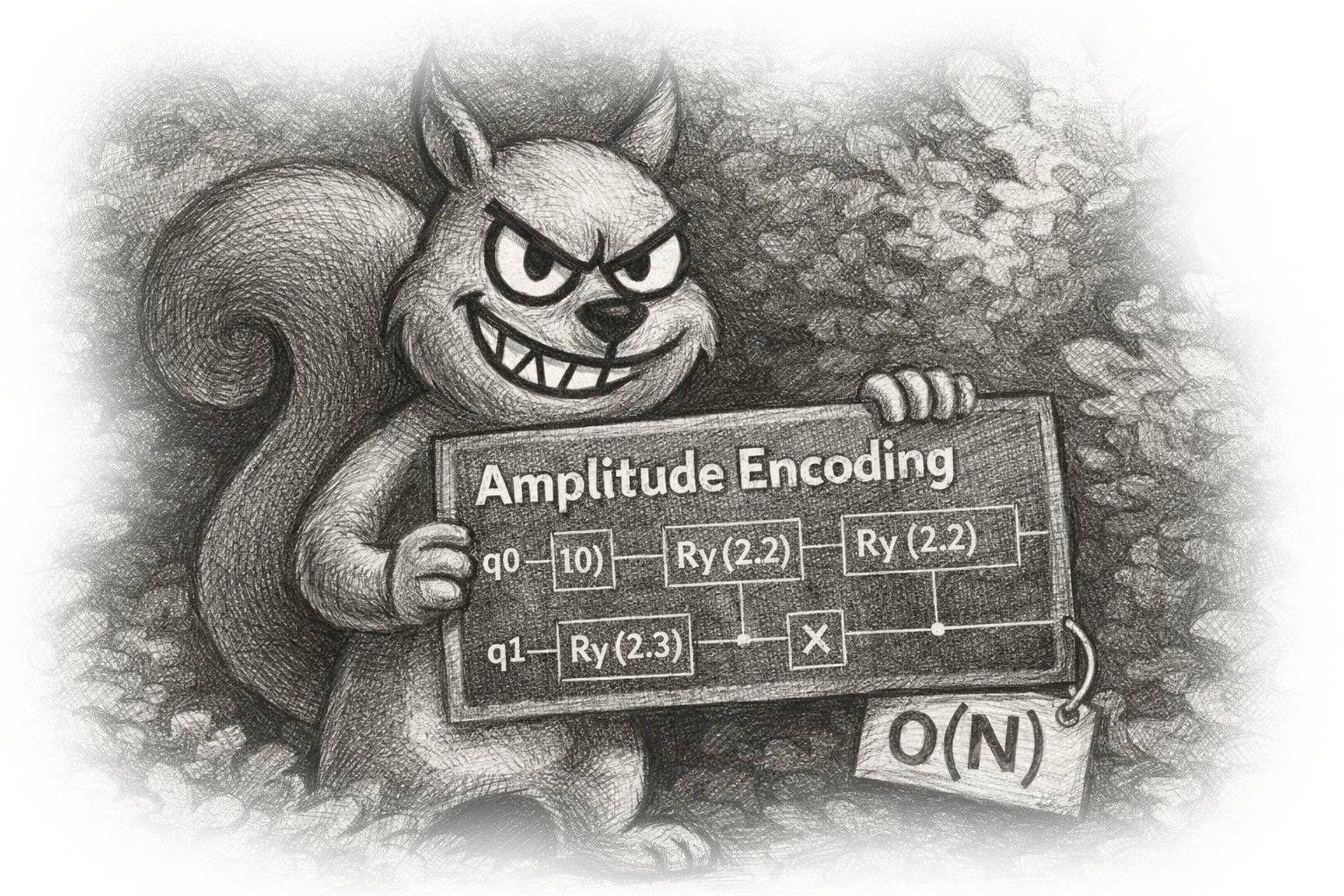
Amplitude encoding represents classical data as the amplitudes of a quantum state's basis vectors. If you have a normalized data vector , it’s encoded into an -qubit state . This allows data values to be stored in only qubits, but preparing the quantum state can be computationally expensive. Learn more about Amplitude Encoding has a non-negotiable cost: loading an -dimensional A vector is a mathematical object that has both magnitude (size) and direction. It’s often represented as an arrow or as an ordered list of numbers (components) that describe its position in space, such as . Vectors are used to represent quantities like velocity, force, or displacement. Learn more about Vector in In quantum computing an amplitude is a complex number that describes the weight of a basis state in a quantum superposition. The squared magnitude of an amplitude gives the probability of measuring that basis state. Amplitudes can interfere, this means adding or canceling, allowing quantum algorithms to bias outcomes toward correct solutions. Learn more about Amplitude typically costs .
To give you an idea of what that means: is the cost of a classical brute-force scan. It's the same asymptotic cost as a classical loop that goes through all values to calculate a norm, check a condition, or perform a comparison with a target.
At this point, however, no quantum computation has taken place yet. This step is still pending.
This ultimately makes Amplitude encoding represents classical data as the amplitudes of a quantum state's basis vectors. If you have a normalized data vector , it’s encoded into an -qubit state . This allows data values to be stored in only qubits, but preparing the quantum state can be computationally expensive. Learn more about Amplitude Encoding unsuitable for problems that can already be adequately solved within this budget.
The use of Amplitude encoding represents classical data as the amplitudes of a quantum state's basis vectors. If you have a normalized data vector , it’s encoded into an -qubit state . This allows data values to be stored in only qubits, but preparing the quantum state can be computationally expensive. Learn more about Amplitude Encoding and acceptance of the upfront costs of a brute force scan only makes sense if we get something in return. Something that we cannot classically do efficiently.
So what does Amplitude encoding represents classical data as the amplitudes of a quantum state's basis vectors. If you have a normalized data vector , it’s encoded into an -qubit state . This allows data values to be stored in only qubits, but preparing the quantum state can be computationally expensive. Learn more about Amplitude Encoding give us in return?
The Entries Become A Single Physical Object
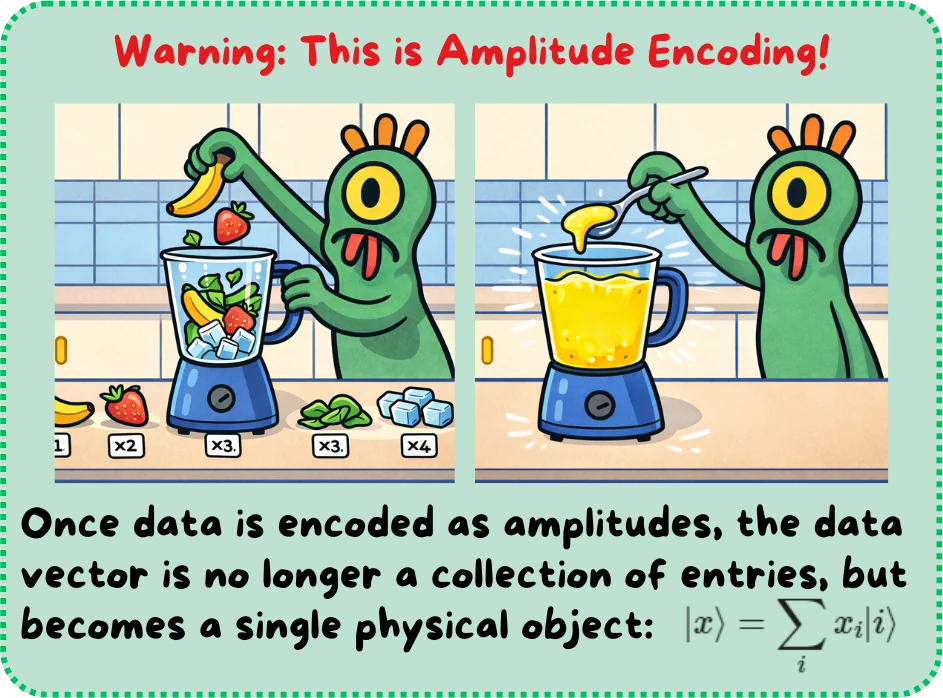
Once data is encoded as In quantum computing an amplitude is a complex number that describes the weight of a basis state in a quantum superposition. The squared magnitude of an amplitude gives the probability of measuring that basis state. Amplitudes can interfere, this means adding or canceling, allowing quantum algorithms to bias outcomes toward correct solutions. Learn more about Amplitude the data A vector is a mathematical object that has both magnitude (size) and direction. It’s often represented as an arrow or as an ordered list of numbers (components) that describe its position in space, such as . Vectors are used to represent quantities like velocity, force, or displacement. Learn more about Vector is no longer a collection of entries, but becomes a single physical object: .
From this point on, we can no longer access individual components. At least not efficiently. Every valid operation must be applied to the entire overlay simultaneously.
However, it is precisely this limitation that enables global operations to be carried out efficiently in return.
A quantum gate is a basic operation that changes the state of one or more qubits, similar to how a logic gate operates on bits in classical computing. It uses unitary transformations, meaning it preserves the total probability (the state’s length in complex space). Quantum gates enable superposition and entanglement, allowing quantum computers to perform computations that classical ones cannot efficiently replicate. Learn more about Quantum Gate are linear and A **unitary operator** is a linear operator ( U ) on a complex vector space that satisfies ( U^\dagger U = UU^\dagger = I ), meaning it preserves inner products. In simpler terms, it preserves the **length** and **angle** between vectors—so it represents a **reversible, norm-preserving transformation**. In quantum mechanics, unitary operators describe the evolution of isolated systems because they conserve probability. Learn more about Unitary Operator When a gate is applied to , it transforms all In quantum computing an amplitude is a complex number that describes the weight of a basis state in a quantum superposition. The squared magnitude of an amplitude gives the probability of measuring that basis state. Amplitudes can interfere, this means adding or canceling, allowing quantum algorithms to bias outcomes toward correct solutions. Learn more about Amplitude simultaneously rather than sequentially. There is no loop over indices. There is only one comprehensive state evolution.
As a result, we can no longer ask, “What is ?” Any attempt to recover individual entries would require repeated In quantum computing, measurement is the process of extracting classical information from a quantum state. It collapses a qubit’s superposition into one of its basis states (usually or ), with probabilities determined by the amplitudes of those states. After measurement, the qubit’s state becomes definite, destroying the original superposition. Learn more about Measurement and cause the state to collapse, thereby erasing the encoded information.
Instead, we can ask questions that have a defining property: their answers depend on all components collectively, not on any one entry.
Global Structure Becomes Directly Accessible
Once a A vector is a mathematical object that has both magnitude (size) and direction. It’s often represented as an arrow or as an ordered list of numbers (components) that describe its position in space, such as . Vectors are used to represent quantities like velocity, force, or displacement. Learn more about Vector is encoded in In quantum computing an amplitude is a complex number that describes the weight of a basis state in a quantum superposition. The squared magnitude of an amplitude gives the probability of measuring that basis state. Amplitudes can interfere, this means adding or canceling, allowing quantum algorithms to bias outcomes toward correct solutions. Learn more about Amplitude the defining global quantities of a A vector is a mathematical object that has both magnitude (size) and direction. It’s often represented as an arrow or as an ordered list of numbers (components) that describe its position in space, such as . Vectors are used to represent quantities like velocity, force, or displacement. Learn more about Vector such as norms, overlaps, and projections, are made visible through Interference in quantum computing refers to the way probability amplitudes of quantum states combine—sometimes reinforcing each other (constructive interference) or canceling out (destructive interference). Quantum algorithms exploit this to amplify the probability of correct answers while suppressing incorrect ones. It’s a key mechanism that gives quantum computers their computational advantage. Learn more about Interference and In quantum computing, measurement is the process of extracting classical information from a quantum state. It collapses a qubit’s superposition into one of its basis states (usually or ), with probabilities determined by the amplitudes of those states. After measurement, the qubit’s state becomes definite, destroying the original superposition. Learn more about Measurement
This means that these things do not have to be calculated step by step anymore. They can be examined directly.
Let's consider similarity. Classically, determining the similarity of two A vector is a mathematical object that has both magnitude (size) and direction. It’s often represented as an arrow or as an ordered list of numbers (components) that describe its position in space, such as . Vectors are used to represent quantities like velocity, force, or displacement. Learn more about Vector requires iteration over all components and the accumulation of partial results. With In quantum computing an amplitude is a complex number that describes the weight of a basis state in a quantum superposition. The squared magnitude of an amplitude gives the probability of measuring that basis state. Amplitudes can interfere, this means adding or canceling, allowing quantum algorithms to bias outcomes toward correct solutions. Learn more about Amplitude coding, similarity becomes a question of state Superposition in quantum computing means a quantum bit (qubit) can exist in multiple states (0 and 1) at the same time, rather than being limited to one like a classical bit. Mathematically, it’s a linear combination of basis states with complex probability amplitudes. This allows quantum computers to process many possible inputs simultaneously, enabling exponential speedups for certain problems. Learn more about Superposition. If two states are prepared and allowed to interfere, their An inner product is a mathematical operation that takes two vectors and returns a single number measuring how similar or aligned they are. In Euclidean space, it’s the sum of the products of corresponding components (e.g., ). It generalizes the dot product and defines geometric concepts likelength and angle in vector spaces. Learn more about Inner Product manifests as a measurable probability.
The same applies to norms. The overall magnitude of a A vector is a mathematical object that has both magnitude (size) and direction. It’s often represented as an arrow or as an ordered list of numbers (components) that describe its position in space, such as . Vectors are used to represent quantities like velocity, force, or displacement. Learn more about Vector is not stored in a single In quantum computing an amplitude is a complex number that describes the weight of a basis state in a quantum superposition. The squared magnitude of an amplitude gives the probability of measuring that basis state. Amplitudes can interfere, this means adding or canceling, allowing quantum algorithms to bias outcomes toward correct solutions. Learn more about Amplitude It is distributed across all In quantum computing an amplitude is a complex number that describes the weight of a basis state in a quantum superposition. The squared magnitude of an amplitude gives the probability of measuring that basis state. Amplitudes can interfere, this means adding or canceling, allowing quantum algorithms to bias outcomes toward correct solutions. Learn more about Amplitude During In quantum computing, measurement is the process of extracting classical information from a quantum state. It collapses a qubit’s superposition into one of its basis states (usually or ), with probabilities determined by the amplitudes of those states. After measurement, the qubit’s state becomes definite, destroying the original superposition. Learn more about Measurement this information is naturally aggregated to give the global size without having to examine the individual components.
Ultimately, linear transformations behave in the same way. When a A **unitary operator** is a linear operator ( U ) on a complex vector space that satisfies ( U^\dagger U = UU^\dagger = I ), meaning it preserves inner products. In simpler terms, it preserves the **length** and **angle** between vectors—so it represents a **reversible, norm-preserving transformation**. In quantum mechanics, unitary operators describe the evolution of isolated systems because they conserve probability. Learn more about Unitary Operator operation is applied to an In quantum computing an amplitude is a complex number that describes the weight of a basis state in a quantum superposition. The squared magnitude of an amplitude gives the probability of measuring that basis state. Amplitudes can interfere, this means adding or canceling, allowing quantum algorithms to bias outcomes toward correct solutions. Learn more about Amplitude-encoded state, it acts coherently on the entire A vector is a mathematical object that has both magnitude (size) and direction. It’s often represented as an arrow or as an ordered list of numbers (components) that describe its position in space, such as . Vectors are used to represent quantities like velocity, force, or displacement. Learn more about Vector Each component is transformed synchronously, and the result remains a single quantum object whose structure reflects the transformation as a whole.
It is important to note that these processes do not run in parallel. If they were only parallel, we could easily solve them on classic computer clusters. The decisive point is that these calculations cannot be divided into independent individual steps. Ultimately, the overall system does not reveal which component made which contribution. Only the collective effect remains.
That is the benefit of Amplitude encoding represents classical data as the amplitudes of a quantum state's basis vectors. If you have a normalized data vector , it’s encoded into an -qubit state . This allows data values to be stored in only qubits, but preparing the quantum state can be computationally expensive. Learn more about Amplitude Encoding while you forego access to individual entries, in return you receive native access to the global structure of the A vector is a mathematical object that has both magnitude (size) and direction. It’s often represented as an arrow or as an ordered list of numbers (components) that describe its position in space, such as . Vectors are used to represent quantities like velocity, force, or displacement. Learn more about Vector from the system.
But Only algorithms that are built to live entirely upon that global structure can benefit. So, Amplitude encoding represents classical data as the amplitudes of a quantum state's basis vectors. If you have a normalized data vector , it’s encoded into an -qubit state . This allows data values to be stored in only qubits, but preparing the quantum state can be computationally expensive. Learn more about Amplitude Encoding is not a general-purpose capability.
So, besides the upfront cost of , Amplitude encoding represents classical data as the amplitudes of a quantum state's basis vectors. If you have a normalized data vector , it’s encoded into an -qubit state . This allows data values to be stored in only qubits, but preparing the quantum state can be computationally expensive. Learn more about Amplitude Encoding comes with another price tag. That is the loss of efficient access to individual entries.
That price immediately narrows the class of algorithms that can make use of Amplitude encoding represents classical data as the amplitudes of a quantum state's basis vectors. If you have a normalized data vector , it’s encoded into an -qubit state . This allows data values to be stored in only qubits, but preparing the quantum state can be computationally expensive. Learn more about Amplitude Encoding
Who's Willing To Pay That Price?
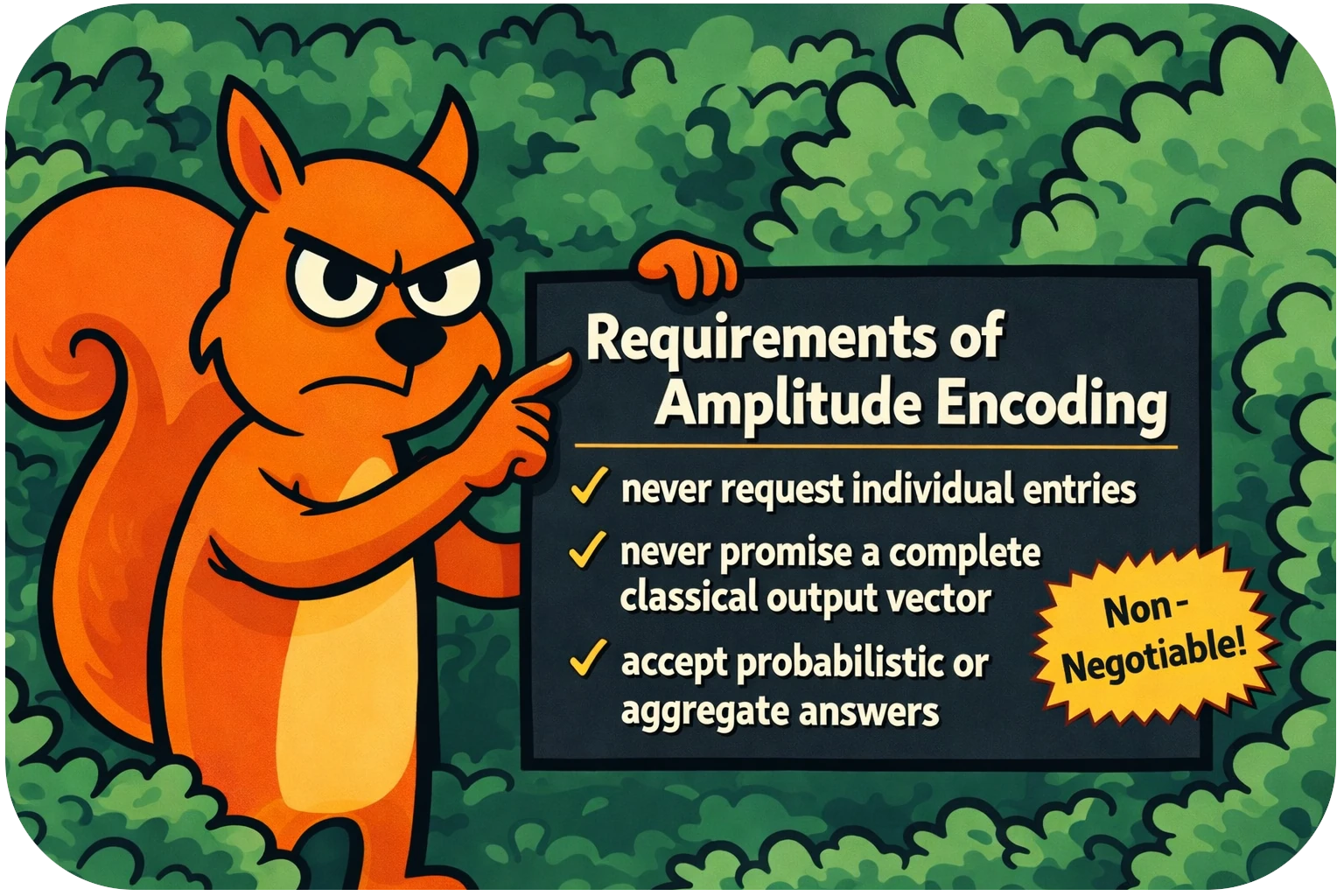
Only algorithms that exhibit the following three characteristic features are suitable for working with In quantum computing an amplitude is a complex number that describes the weight of a basis state in a quantum superposition. The squared magnitude of an amplitude gives the probability of measuring that basis state. Amplitudes can interfere, this means adding or canceling, allowing quantum algorithms to bias outcomes toward correct solutions. Learn more about Amplitude-encoded values.
Join to continue
This part is available to PyQML practitioners and above. Log in or start a subscription to unlock member content.
Already a member? Use Log in. New here? Choose Subscribe.
First, they never request individual entries. At no point do they ask "What is ?" or attempt to recover partial information about the A vector is a mathematical object that has both magnitude (size) and direction. It’s often represented as an arrow or as an ordered list of numbers (components) that describe its position in space, such as . Vectors are used to represent quantities like velocity, force, or displacement. Learn more about Vector Any such request would require a In quantum computing, measurement is the process of extracting classical information from a quantum state. It collapses a qubit’s superposition into one of its basis states (usually or ), with probabilities determined by the amplitudes of those states. After measurement, the qubit’s state becomes definite, destroying the original superposition. Learn more about Measurement and lead to the collapse of the state, destroying the encoded data.
Second, they never promise a complete classical output A vector is a mathematical object that has both magnitude (size) and direction. It’s often represented as an arrow or as an ordered list of numbers (components) that describe its position in space, such as . Vectors are used to represent quantities like velocity, force, or displacement. Learn more about Vector. Their output is not a list of numbers. It is a scalar, a probability, an The expectation value is the average result you'd get if you repeated a measurement of a quantity many times under identical conditions. Mathematically, it’s the weighted average of all possible outcomes, where each outcome is weighted by its probability. In quantum mechanics, it represents the average value of an observable calculated from the wavefunction. Learn more about Expectation Value or some other A quantum state is the complete mathematical description of a quantum system, containing all the information needed to predict measurement outcomes. It’s usually represented by a wavefunction or a state vector in a Hilbert space. The state defines probabilities, not certainties, for observable quantities like position, momentum, or spin. Learn more about Quantum State The success of the algorithm does not depend on the A vector is a mathematical object that has both magnitude (size) and direction. It’s often represented as an arrow or as an ordered list of numbers (components) that describe its position in space, such as . Vectors are used to represent quantities like velocity, force, or displacement. Learn more about Vector being reconstructed in classical memory.
Third, they accept probabilistic or aggregate answers. If the task requires an exact evaluation, randomness is an obstacle. However, for global questions, the answer is by definition an expectation or probability, and randomness is the mechanism that reveals this global property.
If an algorithm requires even a partial check, for example a coordinate, a subset of entries, or a classic approximation of the A vector is a mathematical object that has both magnitude (size) and direction. It’s often represented as an arrow or as an ordered list of numbers (components) that describe its position in space, such as . Vectors are used to represent quantities like velocity, force, or displacement. Learn more about Vector then the In quantum computing an amplitude is a complex number that describes the weight of a basis state in a quantum superposition. The squared magnitude of an amplitude gives the probability of measuring that basis state. Amplitudes can interfere, this means adding or canceling, allowing quantum algorithms to bias outcomes toward correct solutions. Learn more about Amplitude coding breaks down. The cost of the In quantum computing, measurement is the process of extracting classical information from a quantum state. It collapses a qubit’s superposition into one of its basis states (usually or ), with probabilities determined by the amplitudes of those states. After measurement, the qubit’s state becomes definite, destroying the original superposition. Learn more about Measurement exceeds any benefit, and the state must be rebuilt from scratch.
Only algorithms that fully take this lack of knowledge about the components into account can use Amplitude encoding represents classical data as the amplitudes of a quantum state's basis vectors. If you have a normalized data vector , it’s encoded into an -qubit state . This allows data values to be stored in only qubits, but preparing the quantum state can be computationally expensive. Learn more about Amplitude Encoding They must be written from the outset to process entire A vector is a mathematical object that has both magnitude (size) and direction. It’s often represented as an arrow or as an ordered list of numbers (components) that describe its position in space, such as . Vectors are used to represent quantities like velocity, force, or displacement. Learn more about Vector as indivisible objects and extract only as much global information as is necessary to answer the question relevant to them.
Why This Leads Naturally To Specific Algorithm Families
Some algorithms are fundamentally based on a global structure. They never attempt to examine data locally, as their goal is not to analyze entries but to view A vector is a mathematical object that has both magnitude (size) and direction. It’s often represented as an arrow or as an ordered list of numbers (components) that describe its position in space, such as . Vectors are used to represent quantities like velocity, force, or displacement. Learn more about Vector as whole objects.
One such family is quantum Linear algebra is the branch of mathematics that studies vectors, vector spaces, and linear transformations between them. It provides tools for solving systems of linear equations and understanding geometric operations like rotations, projections, and scaling. Its core objects—matrices and vectors—form the basis for much of modern computation, physics, and machine learning. Learn more about Linear Algebra. These algorithms ask questions such as:
How does a linear operator act on a A vector is a mathematical object that has both magnitude (size) and direction. It’s often represented as an arrow or as an ordered list of numbers (components) that describe its position in space, such as . Vectors are used to represent quantities like velocity, force, or displacement. Learn more about Vectoras a whole?
How much of the A vector is a mathematical object that has both magnitude (size) and direction. It’s often represented as an arrow or as an ordered list of numbers (components) that describe its position in space, such as . Vectors are used to represent quantities like velocity, force, or displacement. Learn more about Vector lies in a particular subspace?
What global property does the solution of a system have?
They are satisfied with aggregated answers. A complete classical solution A vector is a mathematical object that has both magnitude (size) and direction. It’s often represented as an arrow or as an ordered list of numbers (components) that describe its position in space, such as . Vectors are used to represent quantities like velocity, force, or displacement. Learn more about Vector is neither expected nor required. This corresponds exactly to what Amplitude encoding represents classical data as the amplitudes of a quantum state's basis vectors. If you have a normalized data vector , it’s encoded into an -qubit state . This allows data values to be stored in only qubits, but preparing the quantum state can be computationally expensive. Learn more about Amplitude Encoding can achieve.
Another family is Kernel methods. Kernel methods reduce learning to a single basic component: similarity. These algorithms never tell you why two A vector is a mathematical object that has both magnitude (size) and direction. It’s often represented as an arrow or as an ordered list of numbers (components) that describe its position in space, such as . Vectors are used to represent quantities like velocity, force, or displacement. Learn more about Vector are similar. They only tell you how much they are similar. This similarity is a global quantity that is calculated from all components together.
Amplitude encoding represents classical data as the amplitudes of a quantum state's basis vectors. If you have a normalized data vector , it’s encoded into an -qubit state . This allows data values to be stored in only qubits, but preparing the quantum state can be computationally expensive. Learn more about Amplitude Encoding converts these primitives into a state overlap. Once the A vector is a mathematical object that has both magnitude (size) and direction. It’s often represented as an arrow or as an ordered list of numbers (components) that describe its position in space, such as . Vectors are used to represent quantities like velocity, force, or displacement. Learn more about Vector are encoded, the A quantum system is any physical system that is subject to the laws of quantum mechanics, whereby quantities such as energy or spin can only assume discrete (quantized) values. Its behavior is described by a wave function that encodes the probabilities of possible measurement results. Learn more about Quantum System can directly estimate the similarity without breaking it down into individual operations per entry.
Check, please
By now, the picture should be clear.
Amplitude encoding represents classical data as the amplitudes of a quantum state's basis vectors. If you have a normalized data vector , it’s encoded into an -qubit state . This allows data values to be stored in only qubits, but preparing the quantum state can be computationally expensive. Learn more about Amplitude Encoding is not efficient in itself.
Amplitude encoding represents classical data as the amplitudes of a quantum state's basis vectors. If you have a normalized data vector , it’s encoded into an -qubit state . This allows data values to be stored in only qubits, but preparing the quantum state can be computationally expensive. Learn more about Amplitude Encoding does not broaden what A quantum algorithm is a step-by-step computational procedure designed to run on a quantum computer, exploiting quantum phenomena such as superposition, entanglement, and interference to solve certain problems more efficiently than classical algorithms. Learn more about Quantum Algorithm can do.
Quite the contrary. It severely limits the scope to very few algorithms. Algorithms whose core questions are, strictly speaking, global in nature and therefore cannot be divided into tasks that can be processed independently of each other. And for this, the initial costs can be amortized.
In quantum computing an amplitude is a complex number that describes the weight of a basis state in a quantum superposition. The squared magnitude of an amplitude gives the probability of measuring that basis state. Amplitudes can interfere, this means adding or canceling, allowing quantum algorithms to bias outcomes toward correct solutions. Learn more about Amplitude coding is therefore not about data compression.
It is not about saving A qubit is the basic unit of quantum information, representing a superposition of 0 and 1 states. Learn more about Quantum Bit
It is not a shortcut for classic data access.
It is an commitment.
You commit to:
working only with global structure
and extracting value through minimal, aggregated In quantum computing, measurement is the process of extracting classical information from a quantum state. It collapses a qubit’s superposition into one of its basis states (usually or ), with probabilities determined by the amplitudes of those states. After measurement, the qubit’s state becomes definite, destroying the original superposition. Learn more about Measurement.
Only algorithms that accept these restrictions can justify the use of Amplitude encoding represents classical data as the amplitudes of a quantum state's basis vectors. If you have a normalized data vector , it’s encoded into an -qubit state . This allows data values to be stored in only qubits, but preparing the quantum state can be computationally expensive. Learn more about Amplitude Encoding
If your problem cannot be completely solved at the global structure level, Amplitude encoding represents classical data as the amplitudes of a quantum state's basis vectors. If you have a normalized data vector , it’s encoded into an -qubit state . This allows data values to be stored in only qubits, but preparing the quantum state can be computationally expensive. Learn more about Amplitude Encoding is simply the wrong abstraction.